Category Archives: spiritual growth
Ann Lamott: I Am That Frog
June 24 at 11:04 AM •
The world can feel like an alcoholic father sitting in the living room in his vile underwear, tranced out or abusive; and the world can feel like your favorite auntie who thinks you are just great, still likes to hike, always brings trail mix, and knows her wildflowers.
These are excruciating times, and this is the kingdom. It’s two, two, two mints in one.
So yeah, some of us are a little tense.
But we are not flattened. Nor do we look away from the suffering of others. And no matter how bad things look and how long change is taking, we don’t give up on goodness. Here is proof: we still take care of each other in ways that are profound, loving and sacrificial, by the bedside of our most beloved, and in the streets. We show up: the secret of life.
We gather in cities to rise up, and at local parks for live music in the sun, where we and our cranky neighbor end up doing the old tribal hippie two-step in the same shaft of light.
We are still laughing—some of us perhaps a bit maniacally—and people are creating the greatest, most live-giving routines and cartoons and responses. This is what saved me during the Cheney years. It was chemo.
So, great laughter, community, joyous and/or sacrificial love. We can work with this!
It is more than enough.
Here’s the one fly in the ointment: we have to do this in dim lighting, what with a political fever dream, and our own failing memories and overwhelm. Life is always like E.L. Doctorow’s great line about writing, that it is like driving at night with the headlights on—you can only see a little ways in front of you, but you can make the whole journey that way.
You still have to buckle up, no matter how slowly the car is moving. Put on the radio and sing along, loudly and off key. You just have to trust that, as John Lennon said, “Everything will be okay. If it’s not okay, it’s not the end.”
I heard a story last week from a sober friend that almost completely captures my understand of goodness and life, a story that has been medicine for my worried, worried soul:
Caroline stopped drinking 30 years ago, at the age of 40, with zero interest or belief in any kind of higher power to whom she might be able to turn when cravings overcame her. But after a year of white-knuckle sobriety, contemptuous of a higher power, hanging on through will power, she one day heard and then found a frog in her shower.
She lifted it and gently carried it in her cupped hands through the house. She could feel and, of course, imagine its terror. She took it out to the garden, where there was a moist patch of earth over near the blackberries, and set it down. It sat stock still for a bit, and then hopped away into the bushes.
She said, “My name is Caroline. I’m that frog.”
I am, too, and I am also a big helper. When I have felt most isolated and lost, I have always ended up being carried back to the garden in people’s good hands, to where I need to be, afraid and not breathing. for much of the way. And I have helped carry scared people, the best I could. You have, too.
Isn’t that what grace is, when some force of kindness, against all odds, with unknown hands, brings us from fear and hard tiles to a moist patch earth, and sets us down?
If I were God’s west coast representative, I would speed up the process a bit, and hand out klieg lights but I can’t. All I can do is to try and help you get back to where there is moist soil and fresh air, and let you help me. And those happen to be the two things I most want in life.
Freedom Comes from Realizing That We Are Blind
“You can’t fill a cup that is already full. That means you can’t approach a new situation, relationship, or job with what you think you know will happen. When you do that, you’re not leaving room for the unexpected, the delightful, and even the miraculous. Try starting from a place of ‘Maybe I don’t know.’ It allows you to be open to something or someone being different from what you experienced in the past. When you approach life in this open way, you also allow the universe to conspire on your behalf. So be empty of expectations. The universe will always dream bigger than you will. Abundance comes when you realize that you can receive what you need-every day.” by Eden-Clark and John Germain Leto
This quote so speaks to my condition right now. One of the hardest things for me is to allow those I care about to hurt. I want to help them find joy even in times of suffering, both for themselves and partly for myself. But suffering is part of the fabric of life and brings opportunities for grace and each of us has our own way and timing for experiencing it and learning from it. And part of loving another person is allowing them to be themselves, even if we are totally convinced we know “better” ways to be. Not being able to help my husband accept the losses that come with his illness or to help him trust that death is only a doorway, not the end, is very painful. And feelings of inadequacy and failure easily become less painful when disguised as frustration and impatience. The quote at the beginning of this showed up as a memory on my face book page today reminding me that my way may not be the best way for someone else and to trust God who loves my husband more than I ever could.
I do relate this experience to Mary’s vigil at the foot of her son’s cross. She had tried to convince him to come home when she realized he was putting himself in danger. She must have struggled with anger when he wouldn’t listen, also with guilt that she had somehow failed him, and with unimaginable heartbreak as she watched him suffer.
In the quote at the beginning of this, I translate “Universe” as God. And however anyone understands salvation, I truly believe that Jesus showed us that this life is not all there is and that suffering has the potential to be redeeming.
And the most counter-intuitive truth he showed us about life was when he prayed from the cross, “Father, forgive them. They know not what they do.” He showed us that forgiveness is the ultimate requirement for love, so that we too can experience forgiveness. Because forgiving others and accepting and experiencing forgiveness are inseparable.
Forgiving others frees us to forgive ourselves, particularly when we have not been able to consciously admit we need forgiveness. We all have the self-righteous belief that our way is the totally right way. And that blinds us to the harm we do. Forgiving others for their blindness both frees and heals us.
Forgiving others is at the core of the command Jesus gave us, “Love one another as I have loved you,” because forgiveness is the very essence of Good Friday.
My prayer for all of us this Holy Week is that we will find the grace to admit the limits of both our own understanding and of everyone’s human blindness, freeing us to both forgive and accept forgiveness. So then, on Easter, we can celebrate the love of God expressed in Jesus and truly rejoice and be glad in it.
“It’s hard to be green!”
Sometimes I get a glimpse of a tiny pattern that reinforces my belief that life has a pattern of purpose.
As an extrovert I don’t necessarily think well, but I think fast. And I used to walk fast, talk fast, and respond quickly to stimuli that I was interested in. My husband Julian as an introvert drove me crazy by having to mull over the smallest decisions and by being so fastidious and careful with what I thought of as unimportant detail, so causing me to always be waiting impatiently on him.
Well, I’ve never focused on physical details. How my babies survived is a witness to the reality of guardian angels. Now, here I am. Me, as Julian’s caregiver, bandaging very painful wounds with complicated modern layers of bandages that do different things. Cutting off bandages near wounds. Wrapping tape around gauze to keep bandages on without putting tape directly on very fragile skin. Getting it tight enough to stay on without putting pressure on the tender places. Not always remembering to place layers and tools strategically so when holding something in place on the wound, I can reach them. Then realizing from the deep sighs that my klutzy slowness is driving him crazy!
Everything I am needing to do right now from filling out government forms with dates and numbers and long forgotten details about health issues is something Julian has always done, because I am so bad at them. And even when he doesn’t sigh or visibly shake his head, I can tell watching him try to explain something some hospital or government agency thinks is important, but makes no sense to me, makes him want to scream.
Now, I’m convinced that part of life really is having to walk in the other guy’s shoes, particularly the one completely different from you, that you mentally judged over and over.
There have certainly been times where I have felt or been inadequate, but I was always pretty good at avoiding situations where it was hard being me. The easiest way was to simply not value those things in life.
Lot’s of luck, guys. Life catches up with you!
2017: Armageddon or There’s Got to be a Pony in it Somewhere?
One of my favorite stories is about psychologists doing a study of pessimists and optimists. They put a young pessimist in a room with every imaginable toy. At first he happily tried out each toy, but soon he sat down crying. When they asked him, didn’t he like the toys, he sniffled “Yes.” But when asked why he was crying, he said, “They are very nice, but I know they will break. Toys usually do. I don’t want to enjoy them and then lose them.”
In the meantime the young optimist was in a room with just horse manure. To their surprise he was happily digging through the pile of manure. When asked why he was so happy, he answered enthusiastically, “With this much manure, there’s got to be a pony in here somewhere!”
I started 2017 with Lumbar Fusion Surgery followed by months of physical therapy, but still ending up in pain when bending and getting in and out of bed. All the bottom cabinets in our apartment are now pretty much unreachable for me. Since I’m short, the upper cabinets have always been out of reach, but now anything unbreakable is accessible with my new reacher. Though I’ve gotten fairly good at tilting things out with the reacher and catching them with my left hand, sometimes I start a chain reaction and all sorts of containers rain down on my head, the counter and the floor. As long as none break open, I just laugh and start over. However, the grits opening mid-air, provoked a different reaction. I’ll just leave it at that.
Shortly after surgery I awoke in the night unable to move my arms. I panicked thinking my arms were paralyzed, until I realized that the Velcro on my wrist braces for my carpal tunnel problem had locked onto the Velcro on my back brace. For a few minutes I thought I was going to have to wake Julian to help me, but I finally managed to get free. I think I did wake him with my laughter. Major blessings in the first several weeks of limited mobility and pain were Julian’s and all our family’s support and help and friends also brightening those days with tasty gifts of food. I felt very loved. And gained five pounds.
Some good news in April was that our Pulmonologist announced that my husband Julian’s Idiopathic Pulmonary Fibrosis had not progressed. But then, he informed us that the scans had shown a tumor in his right lung. The biopsy showed cancer cells, so surgery was scheduled. It was a very scary time. Thankfully, it only took minimally invasive surgery to get all the cancer. So far, in each three month checkup, he is still cancer free. Another blessing in this was his surgeon, who is one of the most intelligent, funny, honest, humble, caring people we have ever met. I told her once that we admired her greatly, particularly because she didn’t think she was God. She laughed and said that she had figured that out pretty early in her life.
However, at the age of eighty-one Julian was now terribly frustrated by how slow his recovery was. Just fourteen years ago he had bounced back pretty quickly from heart surgery. And just as he was finally getting back to work on several architectural jobs, his heart went out of rhythm. So, back to the hospital we went for a Cardiac Ablation. Unfortunately, though the ablation seemed successful, for unknown reasons he began to hemorrhage profusely. The two nurses with him began to take emergency measures to staunch the bleeding, but he was losing consciousness. So, while one lowered the head of the bed to get oxygen to his brain, the other nurse (a tall good looking blonde named Amy) climbed up on the bed to be able to put enough pressure on the incision in his groin to stop the bleeding until the emergency equipment got there. About that time Julian regained consciousness and asked in surprise, “Amy, are you getting in bed with me?” (Hope springs eternal…)
The pressure equipment slowed the bleeding, but a vascular surgeon was called in to do exploratory surgery to see if an artery had been perforated. None could be found even with extensive exploration. So, though the original ablation incision was small, the exploratory one was quite long. Julian now continued to bleed from both surgical sites in the groin area, with the bleeding only very slowly becoming less profuse. A one day stay in the hospital turned into eleven days and he was still leaking fluid with some blood from both sites when they sent us home. I, an eighty year old klutz, who had just had two cataract surgeries in the ten days before this, and had numb fingers and no grip because of carpal tunnel syndrome, would now be bandaging and cutting off bandages on the two adjoining surgical sites about three times a day. Purely through the grace of God, I managed not to do him any further damage and after about another ten days the two sites no longer needed bandages. Julian never admitted to trepidation, but his sigh of relief was quite audible when we finally got to stop playing doctor.
This was now late October. Once again age took its toll and recovery was even slower. Julian lost all appetite, began sleeping excessively, and being untypically sad and even somewhat surly. So, the doctor gave him “cheer up” meds. Lo and behold, he became amazingly energetic, funny and now smiling with a wonderful sparkle in his eyes. We were both delighted. (I considered asking for a prescription for myself.) Unfortunately, he then didn’t shut his eyes for five days and five nights, so the doctor had to switch the meds. With physical therapy he slowly regained some strength once more and began to work again on his much overdue architecture projects.
Suddenly, his legs and feet began to swell and turn bright red. The diagnosis was cellulitis, so now he was again on antibiotics, steroids and having to try to work on his computer with his feet propped up above his heart. I took a photo of this rather hazardous acrobatic endeavor, but wasn’t quite mean enough to post it on face book or my blog. Well….not yet.
The next day he had a meeting to attend on one of his projects. By now, he couldn’t even get his well worn moccasin house shoes on, so I drove him to Walmart to buy some larger backless black house shoes. Since it was raining, he wore socks with plastic grocery bags over them. He put the new shoes on at the checkout counter, but since one foot was swollen less than the other, to keep that shoe on when he walked, he had to sort of shuffle his way out to the car. Well, at least they matched the color of his suit.
Then just as he was beginning to get back to a somewhat diminished “normal,” he developed a horrendous cough and began to have to fight to breathe. We feared the fibrosis had flared up, but it appeared to be an inflammation, possibly because of drastic weather changes and a cold. Back on steroids and antibiotics again. Exhausted by fighting to breathe, he ended up bedridden for several weeks and once more with swollen feet. An unexpected blessing was a recently bought new sofa that was perfect for sleeping with elevated feet on wedges our Steve ordered. He slept there day and night with the remote to control the TV and a view of a flock of cardinals that hang out at the birdfeeders outside the French doors.
Slowly he began once more getting some strength back. But, suddenly while working quietly in his office in our apartment, he was almost paralyzed by extreme pain in his chest that radiated up into his jaw. I got him to the hospital in four minutes. It would have taken the ambulance that long to get to us. Eventually, as they were running tests, the pain subsided and the tests looked okay, but they kept him over night for an echo cardiogram. While waiting for a room, we did our usual survival by humor routine and one of the nurses asked, “You do realize this is an emergency?” We just laughed and said, “We’ve had so many medical emergencies in the last couple of years, we’ve decided that humor is the best survival medicine.”
His heart didn’t show any damage, so he got to go home the next day, but barely in time to change clothes to attend the Developmental Services Banquet. This is our community organization for those with mental handicaps. Julian designed several of their group homes and was a very active member on their board for seven years. For about twenty years he also gave them the monthly stipend he got for being on the City Zoning Appeals Board. Last year we were invited, but he ended up in the hospital so we didn’t make it. This year they gave me a heads up that he was supposed to be given the award he’d missed last year. I think we got there two minutes before it started. So in his suit and tie, wearing his very dilapidated, but fortuitously stretched from wear, moccasin house shoes, he received an award and a lot of affirmation. Many of the award winners were clients with disabilities who work as helpers in the group homes. I was touched by the wholehearted applause and cheering of the other clients. The award presentations were interspersed with Christmas music like, O Holy Night, and the elderly client sitting behind me knew the words to all of them perfectly, but not the tunes. But the sheer joy in her voice brought tears to my eyes as I realized that this too was an answer to my Advent Prayer, “Come, Lord Jesus.” I think Jesus is more visible in the handicapped than in the rest of us.
Our primary care doctor now scheduled Julian for an endoscopy to check for other possible causes for the pain that took us to the ER.
Meanwhile, our son Steve came from Atlanta to spend the weekend creating a wonderland with our collection of Dickens Village buildings, people in many different vignettes, animals, and trees and landmarks of London.
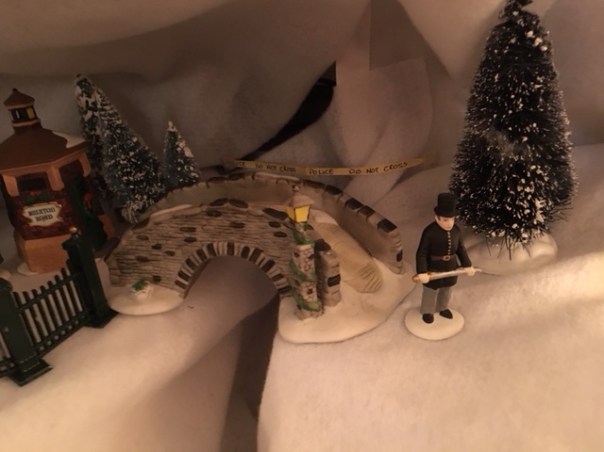
Julian directed this from the couch and it ended up with five levels of hills and valleys with bridges over chasms, a cave, and even a crime scene complete with crime scene tape that our son Tommy made and sneaked into the village a couple of years ago! Well after all, they had a lot of crime in Dickens day too. All the houses, churches, pubs and businesses have lights inside and the sheets of cotton snow cover the few empty patches outside. I think some zoning issues entered into the city planning also.
It really is both beautiful and interesting. And since it has grown to cover the whole end of the living room and now even continues around one corner, there’s no room inside for a Christmas tree. But outside one of the French doors, we have a small lighted one that looms large over the village. If you have to be sick, this is a lot better view than in the hospital. (Well, other than Amy the blonde nurse anyway.)
The next weekend our son Tommy and delightful Whitney with the awesomely beautiful voice brought our four granddaughters and they helped decorate the rest of the house. Then it was fun watching our talented artist granddaughters draw and getting to enjoy Whitney singing with Tommy accompanying her on the guitar. Another truly lovely Christmas experience.
Finally, Julian got to have his endoscopy which showed a pill had become lodged in his esophagus and caused an ulcer. A biopsy done to check for infection was negative. But now the challenge was to avoid the many delicious foods that irritate an ulcer.
A week before Christmas, nineteen of our family arrived for our annual Christmas gathering in a cabin at near-by Montgomery Bell State Park. Our grown children and grandchildren did most of the preparations and helped us organize and pack up our now downsized contributions. The cabin with its large stone fireplace and its wooded setting on a lake is a perfect place for a holiday gathering. The first day, Julian mostly rested, wrapped warmly in a comfortable recliner with everyone taking turns spending time with him and getting him things.
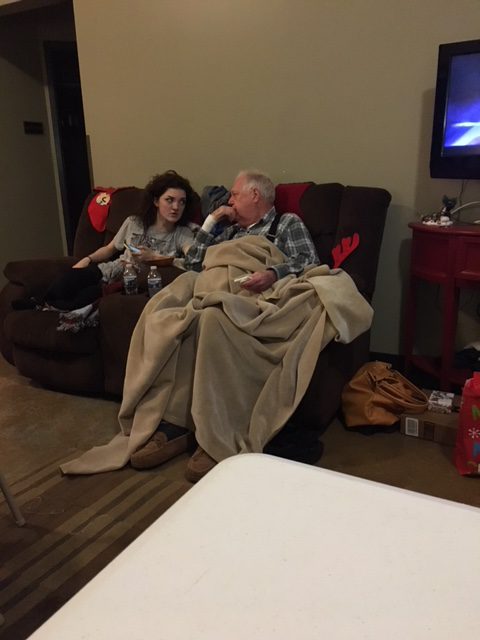
Granddaughter Sophie sharing her hopes and dreams with Julian
By the second day he felt well enough to be beaten at poker by both the grandchildren and great-grandchildren! It was a very happy day with even our grandson who teaches in Bolivia making it back in time. And we got to face-time our son Michael and his spouse Patrick in Cambodia, where they teach at an orphanage for children born HIV positive. I love that I have lived long enough to experience talking with and seeing our loved ones all the way across the world. In spite of all our challenges, it was a wonderful family Christmas celebration.
Christmas week, Julian’s blood pressure started vacillating wildly and he began to have severe chest pain from the ulcer in spite of taking nineteen different medicines each day! Unfortunately, all our doctors were out for a week of Christmas vacation. Adding to his misery, one of his new medicines made Julian very dizzy. He was walking to the bedroom and started to fall as he was almost to the king size bed. I was behind him and began to try to help him get to the bed. He started shouting, “Where’s the bed? Where’s the bed?” Because a week before he had had a sudden drastic loss of hearing, I thought he’d now gone blind! I managed to get him safely onto the bed and asked him if he could see it now and he snapped back, “Of course!” When I asked him why he couldn’t see it a moment before, he replied, “Because I had my eyes closed.” I had a sudden strong desire to strangle him, but fortunately my hands aren’t strong enough.
Now the sparkling lights of the village and the twinkling little tree outside and the bright red cardinals flaming around the feeders were still cheerfully visible over the rather large air purifier, the humidifier, and the walker. They could even be seen between the CPAP and Blood Pressure machine and various breathing aids on the rolling cart that we pulled next to the couch with its pyramid of wedges for elevating feet above the heart. The Christmas angels and burgundy candles around the tray with Julian’s nineteen medicines looked festive on the dining room table. I tried to convince Julian that a wreath of holly would keep his head warmer and add to the Christmassy atmosphere, but he wasn’t in the mood. I was tempted to dig out the left over “happy” pills and slip just a half of one in his milk, but it being the Holy Days, for once I resisted evil.

Village for a Hospital Room
Julian now needed to not lie flat because of the ulcer and he still needed to keep his feet above the level of his heart. I suggested getting a hammock since our middles are our heaviest body area, both head and feet would then be high. But it’s already getting difficult to walk around the apartment, so Julian solved the problem by varying which end he raises with the wedges over the day and night. The other challenge is a diet healthy for his heart, esophagus, and feet. Low salt, low fat, low fiber, no spices, no tomato products, no dairy for two hours before and after a pill he takes twice a day, no caffeine, carbonation, citrus or anything acidic or alcoholic. And the steroids are making his sugar count so high that the frequent tears in his very thin skin won’t heal. So, low sugar also. I spent about three hours grocery shopping during the busiest shopping season of the year reading the contents of everything. But it’s a saving grace to have our son Chris living nearby and willing to come stay while I have to be gone. He and Julian share many interests and it seems to not only be a bright spot in those days for Julian, but to be bringing them much closer to one another. And the many kindnesses of our family and friends have touched Julian’s heart, helping him see how loved he is.
Our newest great-grandson, Raphael, who had a difficult birth on November 15th, didn’t breathe until they resuscitated him. He stayed in the hospital for ten days on a ventilator and needing medicines for seizures. But the neurologist said he could not believe the second brain scans taken at five days old were of the same child as the ones they took the first day. The neurologist actually called it a miracle. Raphael is a beautiful baby and now at two months has a marvelous wide smile. Though we may not know the extent of possible damage for some time, he has many many people praying for him even on the other side of the world. And he is already tenderly loved by all of us. They live in North Carolina, but we get to see photos and videos of him almost daily on face book. And they drove from North Carolina to Tennessee just for four days so his grands and great- grands could get to meet him. So, as 2018 began, I got to hold him and kiss his tiny feet and see him smile and hear his laughter. What a wonderful beginning for a new year.
A beneficial side effect for me of helping Julian through all this has been my regaining stamina and managing a lot of physical activity with very little pain. And in spite of relieving some of the stress by standing at the kitchen counter in the middle of the night eating half a peach pie and another time six jelly doughnuts mysteriously disappearing in two days, I haven’t gained weight.
When someone is in pain, whether physical or emotional, they are focused on the pain, and the small things that keep relationships pleasant are no longer a priority. Through most of our marriage, I have been high maintenance and Julian has been very low maintenance. There have been rough moments for both of us in adjusting to such an extreme change in that now. He doesn’t like to need help and I have always wanted a lot of it. He’s never been comfortable expressing unpleasant feelings. And I don’t really know how to help him, because I worked hard over the years to learn how to deal with my emotions without garbage dumping them on him. So, in spite of being married over half a century, we are still awkward in areas of our relationship. Sometimes, I feel like at eighty years of age, I’m still an amateur person.
Humor has been our glue and in many ways it is still our saving grace. But in this stage of our life, the challenge is to learn how to love across our differences in ways that help us relate heart to heart.
Last week, the doctor explained that a lot of the ongoing illnesses are side effects of some of the medicines that so far are keeping him able to breathe. So Julian is beginning to deal with the reality that his life is not going to get better. In fact, it will be a constant challenge to keep it from getting worse.
It’s a scary and sad time for both of us. Sometimes when he is sleeping, I feel like my heart is breaking and when I let myself cry, I’m afraid I will never be able to stop. Our family and our friends at church have been incredibly loving and supportive. And I find grace by reliving joyful memories of our fifty-nine years together. Julian suddenly lost a lot more of his hearing around Christmas. His expensive hearing aids made his ears itch so he never wore them. But now communication is much more difficult. A friend with similar problems has found something that has helped him and he is bringing it for Julian to try, so I am hopeful that soon we will be able to enjoy reliving those memories together.
Some Memories

Mike Julian Eileen in Los Angeles
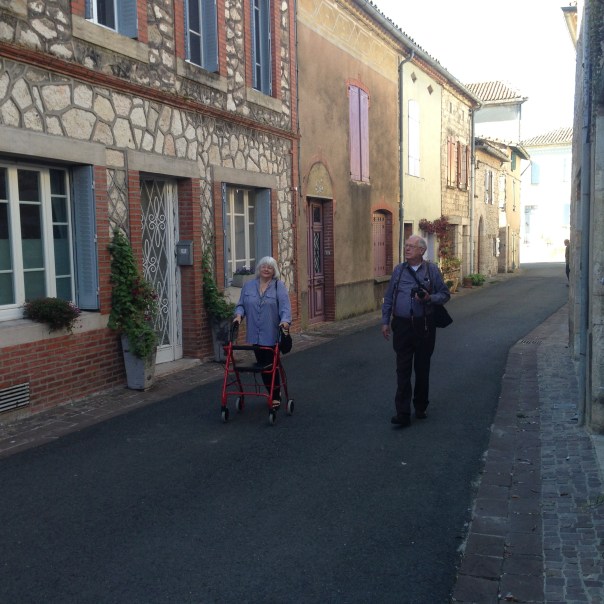
Eileen and Julian in the South West of France 2015

Julian at Tommy’s

Bella and Julian at Hospital
One of the blessings of old age is a treasury of wonderful memories.
A warped sense of humor is also a great help.
Let’s Pretend Our Own Christmas Story
Some of the comments on this led to a lot of learning about ministry to the homeless. Still feel God is calling me to some sort of connection to this ministry, but it’s pretty limited now with Julian so sick.

Let’s pretend Jesus knocked on your door Christmas day to join you for his birthday celebration.
Can you picture him standing there when you open the door? Can you feel your dawning recognition and surprise. Can you sense your moment of doubt, then feel it washed away by sheer joy? Do his eyes have laughter lines as he smiles with just a hint of fun at surprising you. Does his simple kindness surround you like a comforter?
Picture you inviting him in, stammering as you start to reach out to shake his hand, only to be embraced in a warm hug that brings tears of happiness and wonder to your eyes.
Let’s imagine how he might like to celebrate his birthday with you. Do you think he’d be happy if you asked him to sit down, then hurried to get the best lotion in the house to gently rub his…
View original post 436 more words
Humor and Hope
Only when we have experienced humanity in its range and complexity is our humor at its deepest and truest. Redemptive humor is more than the ability to enjoy the isolated humorous situation. It is an attitude toward all of life. Not only is humor a gift of the later years; it is indispensable to hope and healing during that time. Humor recognizes that limitations and failures are not final and unredeemable tragedies. Like a ray of sunshine piercing a dark and overcast sky, humor suggests God’s abiding presence and brightens our human prospects. Humor recognizes the tragedy of the human condition, the finitude which in one way imprisons us. But by laughing at this condition, we declare that it is not final. It can be overcome. Humor is a gentle reminder of the reality of redemption……..Humor is social because the joke is finally on all of us……We are laughing not simply at our own condition but at the shared human condition…………………..A mixture of good and evil is inevitable in this life. Our successes are mixed with failures, our joys contain sadness, love can coexist with hate, health is marred by illness, and possessions are threatened by loss. Excerpt from Winter Grace by Kathleen Fischer.
The rest are my reflections:
Often midlife is the crisis time of recognizing that we have used up as much time as we are likely to have left. So often, it is a time of admitting we have not achieved all we had expected and that there not only may be too little time left, but we may also have to recognize that we do not have all the attributes or resources needed to accomplish our dreams.
There are four roads out of mid-life. 1: Become obsessed and abandon everything and everyone that doesn’t contribute to your goals. 2: Become disillusioned, cynical and angry at life. 3: Choose an addiction to dull the pain. 4: Or adjust our goals to fit a more realistic assessment of our chances to reach them.
Only when we have survived enough of life’s contradictions and made some adjustments to our assumptions can we laugh in the middle of the mix. By then we know that the only thing permanent in this life is change. Often there is a greater freedom to live by our own values and priorities, rather than for an image that pleases others. Hope becomes open ended. We gain a wider perspective for all our limited hopes. And as our lives narrow, we can begin to find true joy in the small things. Happily there are many more small things than large.
Sometimes, as we age we find fulfillment in passing on our hopes and dreams to the next generation, who may be able to take the next step in working toward them. But often, we find more than enough meaning in simple kindness or creating pockets of beauty to be shared with others. Either way, the focus becomes others, instead of our “self.”

