Author Archives: Eileen
The Future is no Scarier than the Past / Old Age has its Perks

at 18

at 20

at 36 with my family

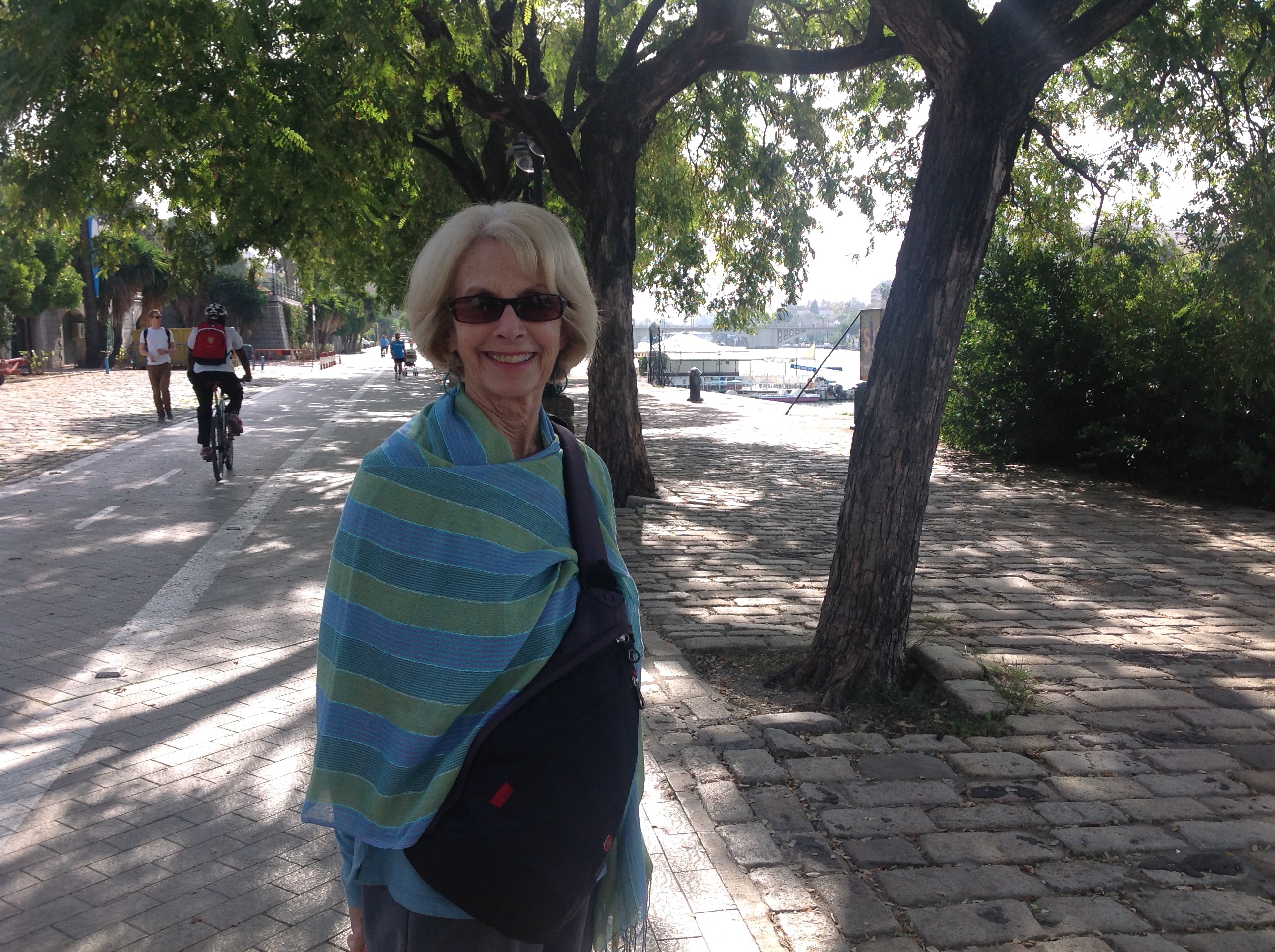
at 75
I finally figured out that all the people I ever was from infancy on still live inside me. It makes for an interesting group most days. And if I don’t like how I feel today, I just return and watch the world when I was having a better time. Young people actually seem impoverished, because they haven’t got a clue about the riches we old guys carry around within us. I wouldn’t trade, because we can go back and be their age inside our memories, but they can’t come forward and enjoy the pleasures of a party without having to drive miles, spend hundreds or pay later with a hangover.
We do know more dead people and we have seen more tragedies up close and personal, so sometimes we hover protectively over our grandchildren. But we can look back at the past and our track record helps us trust that grace will continue to get us through even the hard things the future may bring.
As bad as our world seems in 2015, anyone having experienced life even in America for almost eighty years has witnessed a lot of rough history. Though we now know more about the evil in the world than we once did, the evil was always there. I find when I focus on the evils we haven’t overcome, I fear for coming generations. But when I look back even just on the changes in the world that I have experienced personally, I become more hopeful for the future.
Is having an armed presence in your school any more terrifying than living in homes with blackout curtains for fear of enemy bombers in the nineteen forties or huddling in a school hall during practice warnings of atomic attacks in the fifties. Is the number of families in this generation with members lost fighting in foreign countries anywhere close to the number in the second world war? Is fear born of lack of information as severe now as it was when we huddled around a radio to listen to news of Pearl Harbor or the beaches of Normandy. Children still die or are crippled from disease even in first world countries, but nothing like the numbers in the years before the polio vaccine. Are the numbers of African Americans isolated in ghettos, killed by police, harmed and held back by prejudice anywhere near the numbers in the fifties? Are all the top jobs in the corporate world still held by men? Are people still dying from aids at an alarming rate even in the first world? No matter how horrifying terrorists are today, have they managed inhumanity on the scale of Hitler or Stalin or Pol Pot and the Khmer Rouge, or even Harry Truman at Nagasaki? The answer to all of these is no.
Yes, there are new diseases, new dangers, new stresses and new groups struggling for equality. It is obviously not heaven on earth, but humanity is a work in progress. Our track record gives us reasonable hope that we will find ways to overcome more and more of these problems in each era.
Age, if we look at even our own life span’s historical picture, can give us a perspective.
Parsing Carolyn on Compassion
YES!

This post got a lot of us thinking. I re-post it here with comment and reflection:
My wife Carolyn was a Professor of Psychology and Therapist for many years. I tell people I am her principal client, and this is more true than I care to believe. This morning she was thinking of the awful things that have happened recently in our world, and she penned the following lines that I think call for reflection. She wrote:
“Maybe the horrors in our world are instigated and carried out by the very people who most need compassion and love–but they scare us so much that they trigger more fear and even hate, disgust, depression and despair. These all need compassion, even if we cannot completely understand. Surely our own acts that stem from fear, or lack, or a sense of scarcity, need compassionate and tender consideration? If I am to commit…
View original post 961 more words

The Transforming Joy of Christmas


My favorite Christmas Picture
with permission of the artist, Morgan Weistling
Licensed by the Greenwich Workshop, Inc.
The Transforming Joy of Christmas is the perfect Love for all of us, that came as a vulnerable human baby. A life that not only offers us the unconditional love that can set us free to grow from needing to loving, but also gives us illustrated instructions on how to do it.
Joy to the world for Love has come. Let us rejoice and open our hearts to receive it. Come, Lord Jesus, free us to love.
The Spirituality of the Beatitudes (Paraphrased)
The Beatitudes Describe Spirituality rather than Religion or Law. The word ‘blessed’ is translated here as receiving grace.
The Beatitudes
Graced are the poor in spirit for they are not filled with self, so they are able to be open to God.
Graced are those that accept the pain of loss for they will find the Comforter within instead of seeking an escape.
Graced are those who do not need to own or control anything, for they are free to enjoy the beauty of everything.
Graced are those who know and regret that they are imperfect, for they are free to accept Jesus as their righteousness.
Graced are those who recognize the log in their own eye, for they will seek the love of God and become able to love the unlovable.
Graced are those who are focused on God, for they will find God everywhere.
Graced are the peacemakers, because no cause or group owns them; they belong only to God.
Graced are those persecuted for Jesus’ sake, for they know Jesus.
Graced are the falsely accused and rejected, for they learn to need only God.
Spirituality is foreign to us because it is paradoxical and few of us have had training in grasping paradox. We’re faced with having to lose to win and to die to live. That takes grace more than intelligence, morals, or ethics. And opening to grace takes admitting we need it. That’s the leap of faith that jump starts our spiritual journey.
The Originals are in Matthew 5: 3-11 These are my own paraphrases.
Become Peacemakers: Wars Kill Our Souls
I haven’t posted anything on peace for quite a while, so I am reblogging a post where I tried to put war into a different perspective than just now and us.
From The Upper Room August 6, 2013:
A reflection on Ephesians 4:32
Be kind to one another, tenderhearted, forgiving one another, as God in Christ has forgiven you.
I hated the Americans who massacred so many people, including my sister, with the atomic bomb when I was fourteen. For many years I could neither forgive nor forget what they had done. But as I started to read the Bible, I was challenged and changed by the words of Jesus, “Father, forgive them, for they don’t know what they’re doing.”(Luke 23:34)
In the Lord’s Prayer we pray for God’s kingdom to come and God’s will to be done. We ask for our daily food, forgiveness, and salvation from evil. Then we affirm God’s dominion, power, and glory. For me, forgiveness is a strong and powerful attitude.
Paul said,”Be kind to one another” and “tenderhearted.” When we allow God to make our…
View original post 1,073 more words
Abortion: Do We Choose Law or Love?
Expecting others, who are very different from ourselves and our families and who may live in much harsher environments without the emotional and physical support we have, to make the same hard choices we might make is not even just, never-the-less loving.
This week I voted against Amendment 1 which was to allow Tennessee to write its own stricter laws on abortion.
The following paragraph is from my daughter-in-law who chose to give birth to a wonderful child that she and our son and all our family have loved and nurtured and delighted in for over a decade, even though an ultra sound early in her pregnancy showed that the baby had a serious disability. These are not the words of a woman who chose abortion when she could have.
“Imagine you have a 13 year old daughter. Now imagine that she has been raped or molested and that act of violence resulted in pregnancy. Now imagine sitting in a clinic with her while she is made to watch videos on embryonic growth that are filled with anti-abortion propaganda. All of it intended to make her feel guilt over her decision and change her mind. Just think of how she is being violated all over again because at 13 she cannot bear to carry a child, because at 13 her life would be doomed due to no fault of her own. Imagine it. That’s what Tennesseans voted for last night: victimizing victims.”
Having been in high school and college during the nineteen-fifties, I’ve lived through one cultural extreme to the other: the first being absolutely no abortion, social/religious rejection of unmarried pregnant women, and strongly recommended institutionalization of children born with defects.
To be honest, fear of pregnancy and all that would come with it were the deterrents for me not having sexual relations before marriage, not morality. I simply wasn’t pure or mature enough to be spiritually motivated. I also lived a very protected life and wasn’t aware of women being raped. Being a devout coward, the cultural taboos were a protection for me.
But in the intervening years, I have learned that a surprising number of my many women friends gave up babies in those times. Now, some are reuniting with their “lost” children. I have also had the shock of knowing Christian women who have been raped through absolutely no fault of their own. And I have been the confidant of way too many Christian middle-class women who were molested or violently raped as children by authority figures, some of them close family and supposedly Christian. And I assume this wouldn’t even approximate the number of young girls raped among the economically underprivileged.
However, I find the reality, that society now considers sex just a physical experience on the same moral level as bowel movements and that abortion is used as another form of birth control, totally unacceptable.
This is not as simple an issue as both sides want to make it.
The slippery slope of when an embryo becomes a human being has no clear cut answer. The question of whether defective human beings are of such value that others must sacrifice the quality of their lives to nurture and protect them is also a serious and difficult issue, including the question of who is capable of taking that challenge on. The problem is that those having to make these choices are not all the same. They were not all protected, they are not all intelligent, they are not even all adults, or emotionally stable, they may or may not have been taught the spiritual value of sacrifice, never-the-less the finer points of theology, and their financial situations vary drastically.
This is not an even playing field.
If we want to see the issue as black and white and applicable to all Americans, regardless of whether they believe in a particular religious moral code that calls abortion murder, we are going to have to be consistent about killing as a moral option. Is killing ever moral? When? Why?
Is it moral to send our children by the thousands to kill and be killed fighting in places we have no legal and a very doubtful moral right to invade? Our current response to fear of others in the world is simply to bomb them, killing the innocent along with those we judge as guilty. Is a Syrian child of less value than an American embryo? In a democracy the government represents the people. You and I are as responsible as our leaders and those that aim the bombs.
Can we risk killing those found guilty of killing others within our own society, knowing the statistics on the innocent people that have been sent to their death by our system of justice? Is the jury morally responsible in those cases?
Is it moral to kill in self-defense? Can we morally kill in defense of our property? Are jewels and computers and televisions worth killing a human being who is possibly capable of repentance?
Can we allow people to take their own lives? Can we allow dying people to choose how they die?
Regardless of how we believe we personally would choose, we need to look deep within ourselves, imagining those vulnerable ones we love being the child or person facing these decisions. It’s not just an impersonal theological issue. Do we have the right to make these kinds of decisions for people we know nothing about and that we take no responsibility for the consequences we are insisting on forcing on them?
Law is a Transitory Solution – 2 Corinthians 3:1-4:6
Reality: Law is a transitory solution. Law was needed for humanity to survive long enough to grow past survival of the fittest into living in community. (Sumerian Code 2100-2050 BC; Babylon’s Code of Hammurabi circa 1760 BC; Hebrew Torah 1330 – now; Twelve tables of Roman Law 450 BC)
But law, by its set in stone nature, becomes a tool of condemnation, a way of labeling and separating people even within a community. Law protects people and property, but does not nourish the spirit needed to create a community of love.
Paul says, “Only in Christ is the veil of condemnation (by the law) removed.” Without knowing in heart and mind that we are loved unconditionally, we have no way of getting free of the need to earn and prove our value, often at the expense of others. Since in reality “All fall short of perfection” (the glory of God), no matter what we accomplish or how good we become…..it is never enough. Generally, this leads to settling for believing that we are “better than” another person, another group, another race, another nationality, even another religion. Instead of recognizing our shared humanity, we see people as the “Other” in order to feel good about ourselves. (Pharisees)
But when freed by recognizing the glory (love) of God in Jesus, we begin to become transformed into His image by God’s Spirit within us.
When we acknowledge Jesus as both our Redeemer and as our Lord, we have found the source of grace to grow free to be servants of all. If we continue to go to that well of grace there is less and less need to outperform, have power over, label, or reject others in order to feel better about ourselves. Unfortunately, it’s a big “IF.”
We are all imperfect and all loved as we are. As we grow in our belief in that, we realize “That we are not competent in ourselves. Our competence comes from God.” We do not have to prove anything. Jesus proved with His life and death that we are of infinite value, as servants not only of God, but of ALL others. (Radical inclusivity)
The gospel displays the love (glory) of Christ, who is the image of God. Christ who did not cling to power or importance, but walked in our skin and learned from others, and grew in wisdom and openness to God within, but also accepted failure, rejection, pain, and death for our sake, so we would know we don’t have to earn, win, achieve, anything in our short span here on earth.
All we are called to do is to admit our limits, focus on God’s love for us expressed in Christ and pass it on in whatever ways God gives us.
The Mystery of Suffering
Neither self validation nor self criticism matter. My significance come from who-I-am-as part of a much larger whole, God. And that includes both my good and bad parts. There seem to be only two ways that we know this experientially: prayer and suffering.
These are quotes from Job and the Mystery of Suffering by Richard Rohr.
When suffering comes to you (and sooner or later it comes to everyone), don’t search for any special method of prayer. Just be.
Just sit and accept your cross: accept it totally in the depth of your being. How terribly anguishing, but terribly powerful this method of prayer is. There are many different experiences of suffering, but whatever yours is, don’t try to escape it. Don’t fight it. Just sit with your cross.
Rohr says, To be human means to be imperfect and in process. Grace brings us out of the question of why we are suffering to the amazing recognition, “My life is not about me.” This is the great and saving revelation that comes only from the whirlwind, and we are never ready for it…………We are a continuation of the incarnation, a continuation of the…
View original post 283 more words

