Category Archives: Suffering
The Lion’s Roar or When Our Hearts Are Ready for Anything
A quote by Tara Brach from the blog: Make Believe Boutique
You might ask yourself: “Can I imagine what it would be like, in this moment, to have a heart that is ready for anything?”
If our hearts are ready for anything, we can open to our inevitable losses and to the depths of our sorrow. We can grieve our lost loves, our lost youth, our lost health, our lost capacities. This is part of our humanness, part of the expression of our love for life. As we bring a courageous presence to the truth of loss, we stay available to the immeasurable ways that love springs forth in our life.
If our hearts are ready for anything, we will spontaneously reach out when others are hurting. Living in an ethical way can attune us to the pain and needs of others, but when our hearts are open and awake, we care instinctively. This caring is unconditional—it extends outward and inward wherever there is fear and suffering.
If our hearts are ready for anything, we are free to be ourselves. There’s room for the wildness of our animal selves, for passion and play. There’s room for our human selves, for intimacy and understanding, and for creativity and productivity. There’s room for spirit and for the light of awareness to suffuse our moments. The Tibetans describe this confidence to be who we are as “the lion’s roar.”
If our hearts are ready for anything, we are touched by the beauty and poetry and mystery that fill our world.
With an undefended heart, we can fall in love with life over and over every day. We can become children of wonder, grateful to be walking on earth, grateful to belong with each other and to all of creation. We can find our true refuge in every moment, in every breath. Tara Brach
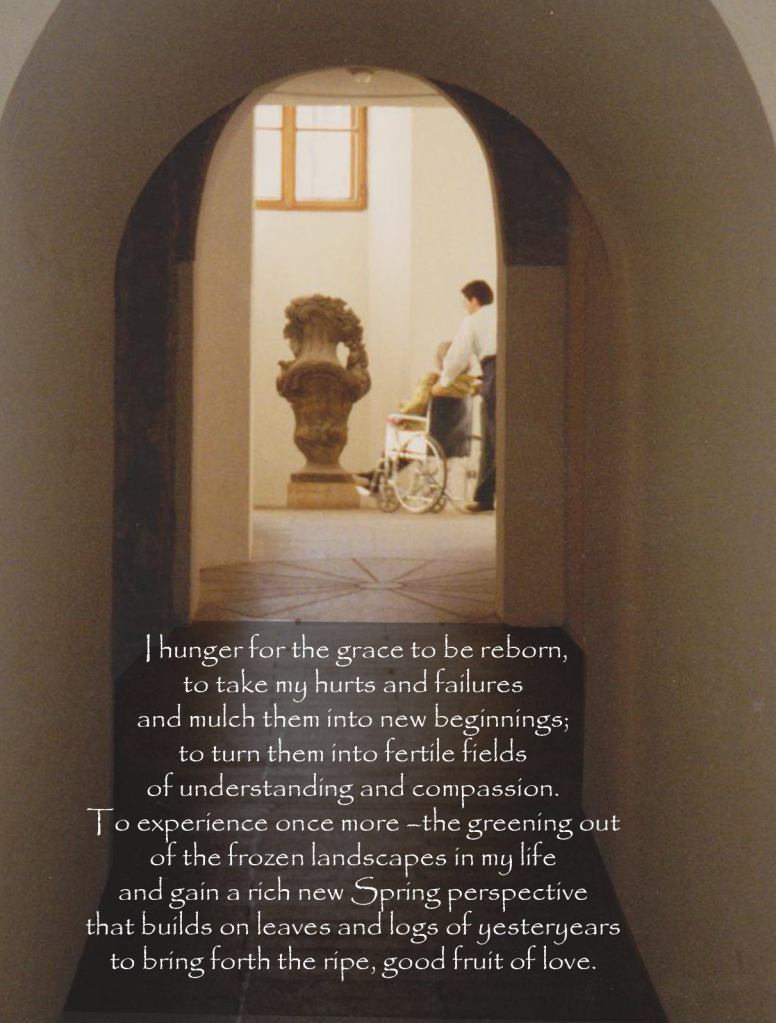
Hungers of the Heart by Richard Watts
WHEN LOVE BREAKS THROUGH, WE ARE SUDDENLY ABLE TO ACCEPT OUR WEAKNESSES AND FAULTS WITHOUT COMING UNGLUED.
“Hungers of the Heart” by Richard Watts.
Watt quotes David James Duncan, who tells about his search that finally brought him to hollowing out a place in his heart about the size of a thimble. Duncan continues, “When I was twenty, in India one day, I turned to God with embarrassed sincerity and said, ‘ Would you care to fill this little thimble with anything?’ and instantaneously, -almost absurdly really, – an undeniable, unimaginable, indescribable lake of peace and love landed on my head in reply.”
Watts continues: “This experience that Christians call grace breaks into the anxiety, confusion and self-doubt that trouble us and frees us to journey along a path toward becoming a real self. ….It need not be as sudden or dramatic as Duncan’s. We need not be “born again;” we live in God’s grace simply by virtue of having been born. Whether for us a breakthrough comes as we look up to the stars, ponder the mysteries of DNA, find someone who loves us, help heal another’s hurt, take a risk for justice, (recognize our limits and helplessness, hit bottom, are forgiven by someone we have harmed* my additions) the experience of being accepted restores us to our real selves.
The paradox is this: that when love breaks through, we are suddenly able to accept our weakness and faults without coming unglued.
We come to accept that even our best impulses are tainted by self-interest, that we pretend to know more than we really know, and to “have it all together” when we really don’t. We begin to see that our strengths are really also our pitfalls: ambition that enables us to achieve can result in a stunted personal life with little time for love and friendship, the pride that allows us to walk in dignity may also keep us from acknowledging our mistakes; the charm that opens doors for us may lapse into shallowness on which we depend without seeking deepening, growth and newness; the intellect in which we trust may mask a denial of the emotions, which one day erupt in us in discomfiting force. (Our tendency to respond to life emotionally may help us understand and reach out to those who are suffering, but since emotions are short term, we may make our choices based on them with consequences that are destructive in the long run.* my addition )
The wonder of grace is that we are increasingly able to see ourselves as we really are without despair.”
And that is the first step to becoming free to grow and change in ways that give us more balanced, appropriate and grace-filled responses to life.
Anatomy of Addiction
Why do some people choose self-destructive addictions?
Some people are just born unsettled, ill at ease with themselves, expecting so much that eventually they just throw in the towel. The pain of failure is too great.
Any addiction in some way lessens our sense of inadequacy. Extreme-housecleaning or obsession with becoming the absolute best in a sport to the detriment of the rest of our lives gives temporary relief; pleasure such as food, drink, sex, escapist reading or watching TV all can deflect us from facing our fears about ourselves. Some of us become addicted to drama by overreacting emotionally to anything even slightly alarming as an excuse to curl up emotionally in a fetal position and expect others to rescue us from any real or imagined dangers. And any of these can move from just a way to relieve stress or feel better about ourselves to a need, an automatic response to unease or pain or fear: an addiction.
Some psychological addictions can be as hard to break as ones that develop a physical component. Some of us simply have addictive tendencies and may just have to work to find one that has the least self-destructive side effects and has the least negative fallout for others.
We can find relief in many acceptable ways to keep our demons at bay. I simply don’t know if we can get perfectly free of them.
One thing I have realized is that some of us not only feel basically inadequate, we fear that we are literally broken and live with a sense that we may at any time fall into the pit of despair or insanity.
Even alcoholism seems preferable to that, because there’s always a hope that you can manage to quit drinking, but you are not sure that you can quit being crazy once you get too out of control. Sometimes the only way to get past that is to go down into your inner bottomless pit and survive. Then instead of Jell-O at your center, you find a rock to stand on. Some of us call that God.


On Becoming A Spiritual Vegetarian
We didn’t end up with ten commandments in order to please God or win heaven. We need them because most of us are generally simply oblivious. We go for the pleasure right in front of us in that moment without stopping to think about the consequences for us and others down the road.
It’s not about being judged or labeled or punished, it’s about love. The basic ten are a gift from God because God loves us enough to try to help us not screw up our lives and others’ beyond repair. Even though God knows how blind we are and forgives us, when we make poor choices we eventually have to face and live with the crippling and often even heartbreaking consequences.
Life is not a test, a contest, or a game we play for prizes.
The rules are about relationships. The basic ten are about how to avoid killing relationships so they have a chance to grow. They are the minimum survival guidelines.
The goal is learning to love enough to have deep, lasting, nurturing, transforming joyous relationships.
The first relationship is with God for the simple reason that grace is unconditional love and God is pretty much the only place you can count on that no matter what stupid thing you do.
I’ve reached an age where I can look back and see the harm even mildly selfish choices have caused not only others, but myself. Because when we continue in a pattern of choosing immediate gratification as we become adults with responsibilities to and for others, it becomes an addiction with painful consequences for both ourselves and them.
Addiction to avoiding discomfort or pain plays out in extremely diverse ways, even in socially approved things that aren’t recognized as addictions. When our marriage relationship starts to take work or involves delayed gratification, some of us simply become workaholics. That way we avoid what makes us uncomfortable and feel virtuous while doing it. Most don’t recognize this as being an addiction, a pattern of escape with consequences similar to using alcohol, infidelity, or running away.
Take another look at the Big Ten. Take another look at your daily choices. Are they healthy for you and for your relationships? Are they about learning to truly love, whatever it takes? Or are they about running from the challenge to do the not always pleasurable daily nitty-gritty it takes to grow up and learn to love.
Tunnel of Fear
Check out the blog, Raising 5 Kids with Disabilities and Remaining Sane’s post “I Drive Like a Horse in Central Park.”
Same theme, more explicit and touching.
Homing through a frost
of silent shooting stars,
the blowing icy flow
of winter’s crystal breath,
my car lights tunnel
through its frozen milky way.
Suddenly, I glimpse a shadow,
a hitcher thinly coated
with the jacketed nonchalance
of adolescent bravado,
James Dean image not quite masking
the soft edges of his youth.
A fragile hope flickers
at my moment’s hesitation,
then quickly disappears
behind me in the night.
My “Good Samaritan” – extinct,
afraid of death – dead of fright.

