Blog Archives
Richard Rohr on Mother Teresa’s Ministry
I do not believe that the lifestyle of the Missionaries of Charity answers all questions or that they are holier than many other Christians I have met. Yet there is a radical and utterly clear gift of God that is revealed through them. I even dared to ask one of the leaders about one of the most common criticisms of Mother Teresa: “Why did Mother not speak out against social injustice? Why did she not point out the evil systems and evil people that are chewing up the poor?”
The answer was calm, immediate, and firsthand. Mother Teresa felt that if she took sides, or played the firebrand, that she could not be what Jesus had told her to be—love to and for all. She said that if she started correcting and pointing out “sinners” she could no longer be an instrument of love and reconciliation for them. Like her patron Thérèse of Lisieux, “her vocation in the church was to be love.” She knew that her primary message had to be her life itself.
Sidewalk Spirituality
Richard Rohr identifies mysticism as a way of knowing accessible to all:
While most Christians consider themselves disciples of Jesus and try to follow his teachings, a smaller number move toward practical acts of service or solidarity. But I’m afraid even fewer Christians have the courage to go on the much deeper mystical path. The most unfortunate thing about the concept of mysticism is that the word itself has become mystified—relegated to a “misty” and distant realm that implies it is only available to a very few. For me, the word “mysticism” simply means experiential knowledge of spiritual things, in contrast to book knowledge, secondhand knowledge, or even church knowledge.
Much of organized religion, without meaning to, has actually discouraged us from taking the mystical path by telling us almost exclusively to trust outer authority, Scripture, various kinds of experts, or tradition (what I call the “containers”), instead of telling us the value and importance of inner experience itself (which is the “content”). In fact, most of us were strongly warned against ever trusting ourselves. Roman Catholics were told to trust the church hierarchy implicitly, while mainline Protestants were often warned that inner experience was dangerous, unscriptural, or even unnecessary.
Both were ways of discouraging actual experience of God and often created passive (and passive aggressive) people and, more sadly, a lot of people who concluded there was no God to be experienced. We were taught to mistrust our own souls—and thus the Holy Spirit! Contrast that with Jesus’ common phrase, “Go in peace, your faith has made you whole” (see Matthew 8:13; Mark 5:34; Luke 17:19). He said this to people who had made no dogmatic affirmations, did not think he was “God,” and often did not belong to the “correct” group! They were people who affirmed, with open hearts, the grace of their own hungry experience—in that moment—and that God could care about it!
Pentecostals and charismatics are significant modern-era exceptions to this avoidance of experience; I believe their “baptism in the Spirit” is a true and valid example of initial mystical encounter.
Richard praises the Franciscan approach to mysticism:
In my experience, Franciscan mysticism is a trustworthy and simple path precisely because it refuses to be “mystified” by, or beholden to, doctrinal abstractions, moralism, or false asceticism (although some Franciscans have gone this route). The Franciscan way is truly a sidewalk spirituality for the streets of the world, a path highly possible and attractive for all would-be seekers. It doesn’t insist every person must be celibate, isolated from others, highly educated, or in any way superior to our neighbors. In fact, those kinds of paths might well get in the way of the experience itself. A celibate monk or nun may have a totally dualistic mind and live a tortured inner life—and thus torture others too. Everyday workers and caregivers with mystical hearts and minds can enlighten other individuals, their families, and all they touch, without talking “religiously” at all.
Raphael Now
At two weeks Raphael is finally off all tubes. He’s breathing on his own and taking a bottle. His bodily functions are all working. He’s focusing his eyes.

Raphael on Monday, November 27th, 2017
He is still on medicine for seizures, but it is controlling them. His heart showed a flutter over the weekend, but I haven’t heard any more about that. But please keep the prayers going. About five days after he was born the neurologist called and told Raphael’s parents that he would not have known the second brain scan was of the same baby as the first, it was so much improved. When we care and pray for one another, miracles can happen. Thank you all for your caring prayers.
.

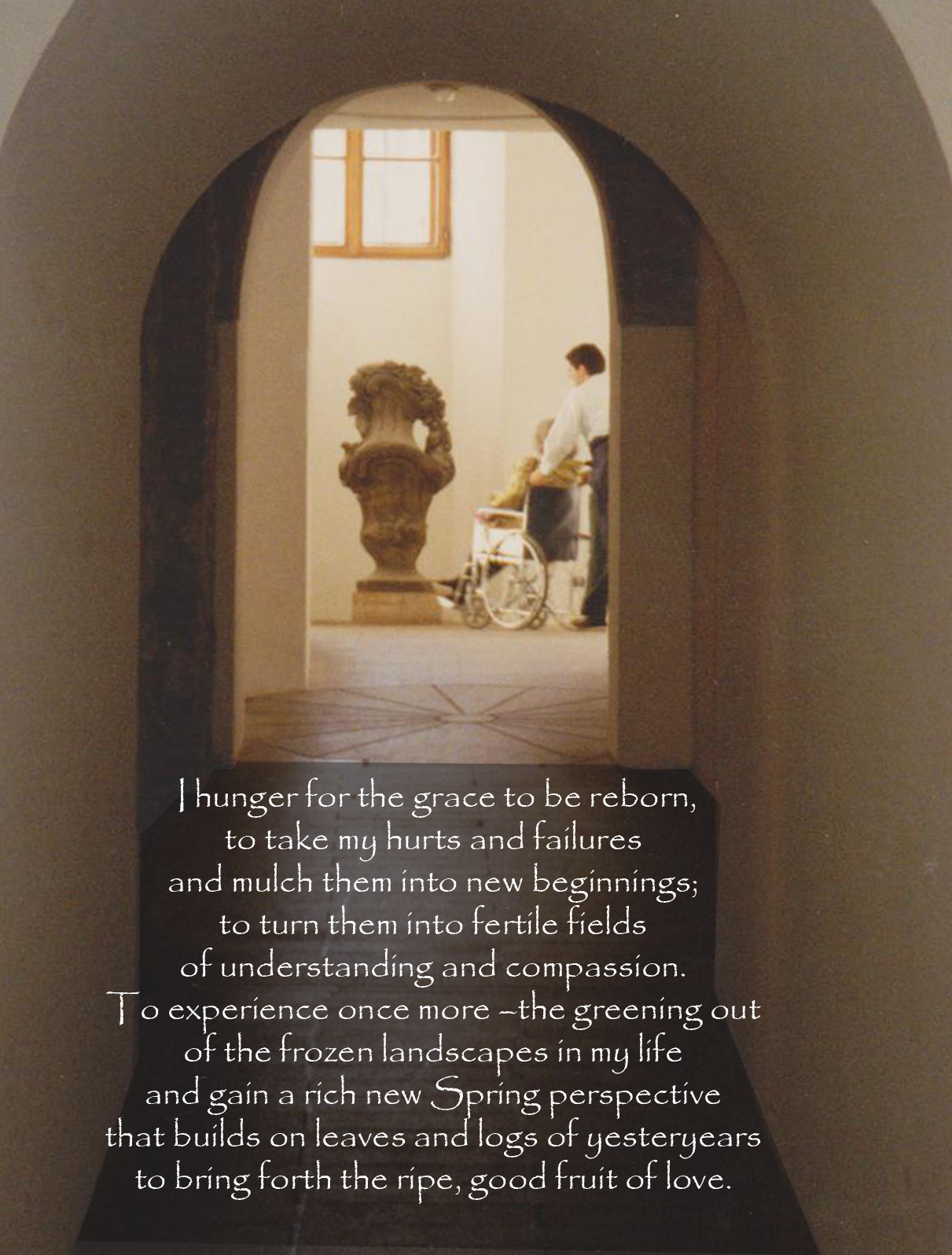
I Pray for Grace
to get it right now that I am old.
to give love and joy, never heartbreak.
to hold all lightly, free to let go.
to seek God’s hand when I suffer.
to forgive others and be forgiven.
to have faith there is some great purpose,
an after- life better than this one.
to while still in dark, believe in light.
and to go with hope into the night.
The Commandments: Humanity’s Keys for Survival/The Beatitudes: Our Handbook for Freedom to Love
I’m pretty sure that law and the concept of sin and consequences were created to try to help us live in the groups we need to survive and prosper. Society is a two edged sword. It keeps us from having to do everything for ourselves from fighting off wildlife, planting, harvesting, to creating clothes and shelter, thus giving us time to think, create, explore, and ask questions about the why, not just the how. But, since humanity is a work in progress…..the old adage, that there’s both a goody and a baddy to everything, holds true for society. Society helps us survive physically, but it also challenges us to learn to love.
The commandments were first of all, simply practical. The laws were aimed at keeping us alive, both as individuals and humanity, long enough to become loving. Whatever the Intelligence called God is, that created and nourishes life, it lives within each of us. It is a source of grace to become more loving, than competitive and combative. And we are like cells in a body. Each of us not only affects those closest to us, we affect the whole for better or worse, even the generations following us.
Self-honesty and understanding, rather than guilt, are the beginning of learning to love. And those take courage and grace. The divorce rate makes it obvious we haven’t become enough like Jesus to even love those closest to us, never-the-less those different from us or even “against” us. The commandments are the basic tools of survival for society. But, Jesus showed us the next level through teaching and living the spirituality of the Beatitudes. They call us beyond the fundamentals of the Commandments and just survival. They call us to freedom, the freedom to love others.
Caring is prayer. Prayer is in the intention, whether expressed in words, thoughts, feelings, candles, symbols, acts of kindness, or forgiveness. There is power in prayer. But both wisdom and love are needed to use the power for others, to understand that all creation, without exception, is one.
Jesus is a turning point in humanity’s journey. He fleshed out a love that sacrifices for not only the weakest physically, but the weakest spiritually. This is not survival of the fittest.
His resurrection also illustrated that this life span isn’t all there is. Jesus is the living example of the potential of God’s grace even within our own humanity.
His resurrection shows us death is simply a door to eternity. When we believe this, it gives us a very different value system than death as the finish line. And His openness and love for all show us the way to overcome the finality of death.
What Does Love Mean?
Some 4 to 8 year olds were asked:
‘What does love mean?’
Here are their answers. (Don’t know if this factual, but good anyway.)
‘When my grandmother got arthritis , she couldn’t bend over and paint her toenails anymore. So my grandfather does it for her all the time, even when his hands got arthritis too. That’s love.’
Rebecca- age 8
‘When someone loves you, the way they say your name is different.
You just know that your name is safe in their mouth.’
Billy – age 4
‘Love is when a girl puts on perfume and a boy puts on shaving cologne
and they go out and smell each other.’
Karl – age 5
‘Love is when you go out to eat and give somebody most of your French fries
without making them give you any of theirs.’
Chrissy – age 6
‘Love is what makes you smile when you’re tired.’
Terri – age 4
‘Love is when my mommy makes coffee for my daddy and she takes a sip
before giving it to him, to make sure the taste is OK.’
Danny – âge 8
‘Love is what’s in the room with you at Christmas if you stop opening presents and just listen.’
Bobby – age 7
(Wow!)
‘If you want to learn to love better , you should start with a friend who you hate. ‘
Nikka – age 6
(we need a few million more Nikka’s on
this planet)
Love is when you tell a guy you like his shirt, then he wears it everyday.’
Noelle – age 7
‘Love is like a little old woman and a little old man who are still friends even after they know each other so well.’
Tommy – age 6
‘During my piano recital , I was on a stage and I was scared. I looked at all the people watching me and saw my daddy waving and smiling. He was the only one doing that. I wasn’t scared anymore.’
Cindy – age 8
‘My mommy loves me more than anybody. You don’t see anyone else kissing me to sleep at night.’
Clare – age 6
‘Love is when Mommy gives Daddy the best piece of chicken.’
Elaine-age 5
‘Love is when Mommy sees Daddy smelly and sweaty and still says he is handsomer than Robert Redford.’
Chris – age 7
‘Love is when your puppy licks your face even after you left him alone all day.’
Mary Ann – age 4
‘
I know my older sister loves me because she gives me all her old clothes and has to go out and buy new ones.’
Lauren – age 4
‘When you love somebody , your eyelashes go up and down and little stars come out of you.’
Karen – age 7
‘Love is when Mommy sees Daddy on the toilet and she doesn’t think it’s gross..’
Mark – age 6
‘You really shouldn’t say ‘I love you’ unless you mean it. But if you mean it, you should say it a lot. People forget.’
Jessica – age 8
And the final one was a four year old child whose next door neighbor was an
elderly gentleman who had recently lost his wife.
Upon seeing the man cry , the little boy went into the old gentleman’s yard , climbed onto his lap , and just sat there. His Mother asked what he had said to the neighbor , the little boy said ,
‘Nothing , I just helped him cry’
************************
On Becoming A Spiritual Vegetarian
We didn’t end up with ten commandments in order to please God or win heaven. We need them because most of us are generally simply oblivious. We go for the pleasure right in front of us in that moment without stopping to think about the consequences for us and others down the road.
It’s not about being judged or labeled or punished, it’s about love. The basic ten are a gift from God because God loves us enough to try to help us not screw up our lives and others’ beyond repair. Even though God knows how blind we are and forgives us, when we make poor choices we eventually have to face and live with the crippling and often even heartbreaking consequences.
Life is not a test, a contest, or a game we play for prizes.
The rules are about relationships. The basic ten are about how to avoid killing relationships so they have a chance to grow. They are the minimum survival guidelines.
The goal is learning to love enough to have deep, lasting, nurturing, transforming joyous relationships.
The first relationship is with God for the simple reason that grace is unconditional love and God is pretty much the only place you can count on that no matter what stupid thing you do.
I’ve reached an age where I can look back and see the harm even mildly selfish choices have caused not only others, but myself. Because when we continue in a pattern of choosing immediate gratification as we become adults with responsibilities to and for others, it becomes an addiction with painful consequences for both ourselves and them.
Addiction to avoiding discomfort or pain plays out in extremely diverse ways, even in socially approved things that aren’t recognized as addictions. When our marriage relationship starts to take work or involves delayed gratification, some of us simply become workaholics. That way we avoid what makes us uncomfortable and feel virtuous while doing it. Most don’t recognize this as being an addiction, a pattern of escape with consequences similar to using alcohol, infidelity, or running away.
Take another look at the Big Ten. Take another look at your daily choices. Are they healthy for you and for your relationships? Are they about learning to truly love, whatever it takes? Or are they about running from the challenge to do the not always pleasurable daily nitty-gritty it takes to grow up and learn to love.
What If It Only Takes Ten More People Becoming A Little More Loving to Change the World?
I have been reading and learning a lot about forgiveness. We all have different proclivities for how we handle anger and hurt. Recently a blog post about our responses to horrifying acts of terrorism against innocent children challenged me to explore the polarities of love and anger and forgiveness.
I’m not sure about this, but some scriptures and some experiences I have had myself make me suspect that forgiving someone has healing power not only for ourselves, but for the offending person. And here’s the freaky part: it can happen concretely simultaneously across great distances without being communicated. I can’t prove it. I have not read anything much about it, but I have had some minor, but thought provoking, experiences.
Also, years ago, I read a small book called “The Hundredth Monkey” which had some research statistics that claimed that monkeys on separate islands and continents can suddenly simultaneously learn new “human” kinds of skills. Their conclusion was that when a certain level of a population of a species acquire a new trait or ability, it somehow triggers a leap in the species across the world. And the author’s hope was that if we as individuals became peaceful, eventually the critical number of our species would bring about world wide peace.
I kind of liked the idea and shared it with friends, but my logical self was very dubious. And since statistical studies such as this can seldom control all the variables, I took this with a grain of salt. Until recently when driving, I hesitated to start across an intersection when the light turned green because more and more people are running lights right after they turn red. And sure enough someone did. In the last four or five years I have observed a steady increase in this disturbing phenomena.
Something clicked for me today. Is this a negative example of the “hundredth monkey” theory?
Again, as David Hume taught, cause and effect are almost impossible to prove, which is why we measure statistical probability. But even a remote possibility that our own small struggle to become more loving, forgiving, peaceable people might have a lot more significance for the larger scheme of things would be reason enough to expend more serious time and effort on that project!
Most of us reach a point in our lives where we recognize that we cannot change others, we may can facilitate their attempts to change, but we can’t make anyone want to change and we can’t magically change them even when they seek change. It’s a helpless feeling and tends to make us feel pretty hopeless about things like drug addiction, terrorism and war, and the gross inequality of resources and standard of living across our planet. And even when we are consciously on a Spiritual journey putting time and effort into becoming more loving, forgiving, and peaceful, there are times it hardly seems worth the struggle, if we are managing at least to avoid breaking the big “TEN” in case there really are a heaven and a hell.
What if it matters a lot more than we can imagine for us to clean up our only mildly toxic act: our cursing bad drivers, keeping people out of our lane when they have ignored the warning that theirs is closed further down the road, turning people against one another through gossip, holding grudges, spending a major part of the rest of our lives seeking vengeance under the name of justice for real harms done us or those we love, or even just blaming everyone else for our own failures?
I tried to teach my children to judge the effect of their actions by the age old excuse, “Everybody else is doing it.” What will the world become like if everyone else does what you are doing? What will hotels have to charge if every person steals a towel or a pillow? What will driving anywhere be like if everyone drives like it’s a race to beat out all the others?
Or maybe even more pertinent, perhaps everyone not doing the same things you are not doing. Not offering help to someone that hurt our feelings, not reaching across differences, not sharing from our abundance because we assume the worst of others. Not picking up trash. Often we simply ignore our sins of omission.
The infamous butterfly fluttering on the other side of the world isn’t making a moral choice, but we do each make numerous moral choices as to what we do or neglect to do each day.
What if it only takes ten more truly loving people to change the world? Not by their accomplishments, but by their love, forgiveness, and peace? Will you and I be one of that ten?

