Blog Archives


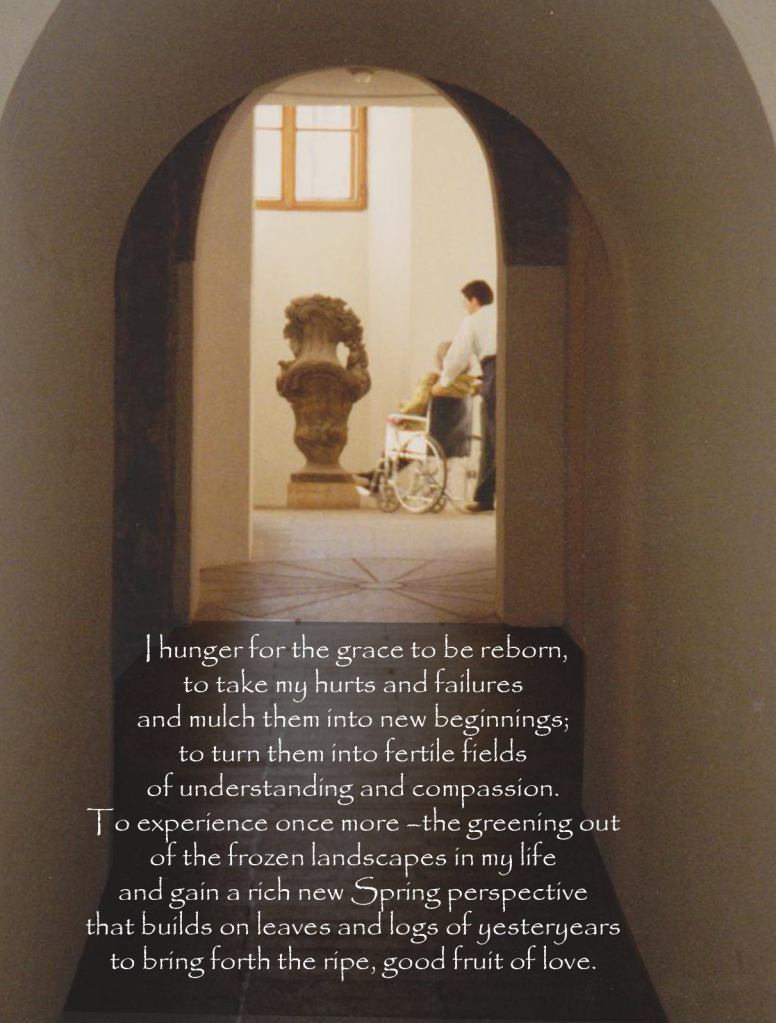
The Broken Body
Reflecting on the Body,
you the hand, I the foot
Christ the head, perhaps the heart,
all at times the hidden part,
I let the Scriptures
flood my mind with images,
with suddenly one image,
a moving picture
so harshly real
I gasp aloud.
A person staggers
stumbles forward,
arms flailing, head jerking
back and forth in spasms,
body parts all pulling
different ways.
This then, reality,
Christ’s earthly body now.
God, forgive us.
Becoming Free to Hear God
I just want to reiterate my theme song: We are all born different.
I don’t have expertise in much, but personality differences have been my area of specialization since the early 1980’s. I used to be a consultant on their implications for marriage relationships, teaching/learning styles, approaches to spirituality and even management skills.
We are different in both what and how we take in information from the outer world
We are different in how we process what we take in.
We are different in what we value.
So, we are different in how we respond to what we take in.
We are incredibly different in how we communicate.
We are different in how we live in the world……whether goal driven, pleasure driven, influenced by others or our own built in agendas.
We are different in whether we are focused on the present moment, the past or the future.
Words have different meanings and even a totally different impact for each of us.
It is an absolute miracle that any random group of us can agree or act in concert on anything, even in the same family, church, culture or country, never-the-less across cultures, religions, and nationalities.
However, both my studies and experience have shown me that after midlife we have a natural inclination to grow and develop more in the opposite strengths and orientations. So, age may have its perks and probably the greatest of these is a greater potential for peacemaking.
Here is a part of my personal journey that hopefully illustrates this possibility.
In my mid-forties I was accepted into a three year course of preparation for Lay Ministry.
A part of it was taking a battery of tests ranging from IQ to personality tests. Then we were given feedback on areas that might be problematic for ministry.
I was told that I had two areas with a potential for limiting my effectiveness in ministry.
#1. My IQ was high enough that I most likely always assume that I am right in any conflict of opinion. This is a weakness, because no matter how smart anyone is, no one, but God is right all the time. And….(here is the zinger) the most necessary quality for hearing God is humility.
#2. I was over sensitive and thus, easily offended.(My humorous, but pitiful first gut level response to this was, “If you know that, why would you hurt my feelings by telling me?”)
It has been a long and somewhat painful process of integrating these truths into my conscious responses to life.
Several years ago, I got into a conflict with my church’s Minister and the leadership of the church. This culminated with a woman Elder telling me that I was just an unhappy person who was never satisfied with anything. Frustrated, hurt and angry, I left organized religion for about two years. During this period I focused on trying to listen to God and my relationship with God became much closer and more fruitful. This culminated in the realization that I was, in fact by nature, both extremely idealistic and a perfectionist. These traits have a good side; I have been at times a change agent for the better. However, since no person or organization is perfect, they tend to make me critical of pretty much everyone and everything.
The realities and practical limits of an imperfect world filled with imperfect people, including myself, are like a pebble in my shoe. Coming to grips with the reality that in this life, we can only inch toward any ideal, never reach it, is as painful for the idealist as accepting the call to change is for the pragmatist. The ultimate challenge for all of us is becoming free to hear God in each situation. Sometimes God’s choice is a matter of timing, sometimes what seems good, may need to be let go to make way for something better as yet unseen, sometimes more time is needed for grace to change other hearts.
This is my prayer variation: “God, help me to change what you want me to change, to accept what you want me to accept, and to hear which you are calling me to do in each situation.”
Here are the challenges that I am still in the process of learning on how to hear God:
#1. I must let go of the assumption that my way of seeing an issue is the best or God’s way. It might actually be, but I cannot see the whole picture or the long term effects like God can, so I cannot make my opinions into idols.
#2. I must consider the realities or practical limits of the situation and be willing to inch toward or even let go of what I consider the ideal.
#3. I must let God heal the hurt behind the anger that any conflict carries with it, such as feeling unappreciated, rejected, like a failure, or somehow inadequate.
#4. I must trust that God is in every situation and can teach me and others what we need to bring about spiritual growth and good out of what seems so wrong.
#5. It may be necessary for us to take time and space to heal our wounds, but we need to avoid burning bridges. Sin isn’t feeling hurt or angry or even needing time away from a situation.
Sin is refusing to take the time to seek the grace and do the work needed to reconcile, however long that may take.
Can Misuse of Free Speech Be Considered Use of a Deadly Weapon?
In the 1950s our home in Houston, Texas was bombed, because my newspaper editor father had endorsed the first African American candidate running for a position on the local school board. Though no one was injured, as a teenager it was terrifying to feel so vulnerable to a hatred I couldn’t understand. So, I am certainly not an advocate for terrorism. And as both the daughter of one newspaper editor and the mother of another, I am a strong supporter of freedom of the press, but not of a press without a conscience.
Words can be as inflammatory as bombs, as most revolutions have proven. Certainly sarcasm and ridicule are generally recognized as deadly for peaceful relationships, whether personal or political.
The violence involving the newspaper Charlie Hebdo in France seems almost a chicken and egg situation with both sides shooting from the hip at anything they don’t like. We tend to applaud the revolutions seeking democracy, violent or not, because we understand them. Other than the Irish, most of us don’t understand the ones that use a religious excuse for violence as a way out of being helpless as a minority.
So much of the violence in the world, even genocide, grows out of a long and painful history of conflict, that is only known up close and personally by the participants. The rest of us only see the resulting boiling over of centuries of equally shared hate filled interactions.
I certainly don’t know the solution, but in my eighty-two years as an American, I’ve been taught to fear, and thus hate, the Germans, the Japanese, the Italians, the North Koreans, the Russians, the Chinese Communists, the North Vietnamese, the Pot Pol Cambodians, the Communist Cubans, Al Qaeda, the KKK and more.
Though I accepted America’s excuse of shortening World War Two by dropping atomic bombs on two civilian Japanese cities that resulted in at least 250,000 civilian casualties, from much of the world’s view, Harry Truman could be grouped with Hitler, Stalin, and Pol Pot as a mass murderer of the innocent.
How do we begin to break the unending cycles of fear and hate that perpetuate violence?
I oppose violence in any form, including vindictive, abusive, ridiculing, hate filled and irresponsible writing, cartooning or speech. Again, I wholeheartedly support the right of free speech, but not freedom from conscience or responsibility. Ridicule is not an effective response to any threat. It is self-serving egotism. It simply pours fuel on the fire.
Pouring fuel on the fires of hate and fear, however we do it, is not only immoral, it is self-defeating. Every one of us is called to become a peacemaker in whatever way we can. There are no winners in wars. Violence of any kind kills our souls.
What If It Only Takes Ten More People Becoming A Little More Loving to Change the World?
I have been reading and learning a lot about forgiveness. We all have different proclivities for how we handle anger and hurt. Recently a blog post about our responses to horrifying acts of terrorism against innocent children challenged me to explore the polarities of love and anger and forgiveness.
I’m not sure about this, but some scriptures and some experiences I have had myself make me suspect that forgiving someone has healing power not only for ourselves, but for the offending person. And here’s the freaky part: it can happen concretely simultaneously across great distances without being communicated. I can’t prove it. I have not read anything much about it, but I have had some minor, but thought provoking, experiences.
Also, years ago, I read a small book called “The Hundredth Monkey” which had some research statistics that claimed that monkeys on separate islands and continents can suddenly simultaneously learn new “human” kinds of skills. Their conclusion was that when a certain level of a population of a species acquire a new trait or ability, it somehow triggers a leap in the species across the world. And the author’s hope was that if we as individuals became peaceful, eventually the critical number of our species would bring about world wide peace.
I kind of liked the idea and shared it with friends, but my logical self was very dubious. And since statistical studies such as this can seldom control all the variables, I took this with a grain of salt. Until recently when driving, I hesitated to start across an intersection when the light turned green because more and more people are running lights right after they turn red. And sure enough someone did. In the last four or five years I have observed a steady increase in this disturbing phenomena.
Something clicked for me today. Is this a negative example of the “hundredth monkey” theory?
Again, as David Hume taught, cause and effect are almost impossible to prove, which is why we measure statistical probability. But even a remote possibility that our own small struggle to become more loving, forgiving, peaceable people might have a lot more significance for the larger scheme of things would be reason enough to expend more serious time and effort on that project!
Most of us reach a point in our lives where we recognize that we cannot change others, we may can facilitate their attempts to change, but we can’t make anyone want to change and we can’t magically change them even when they seek change. It’s a helpless feeling and tends to make us feel pretty hopeless about things like drug addiction, terrorism and war, and the gross inequality of resources and standard of living across our planet. And even when we are consciously on a Spiritual journey putting time and effort into becoming more loving, forgiving, and peaceful, there are times it hardly seems worth the struggle, if we are managing at least to avoid breaking the big “TEN” in case there really are a heaven and a hell.
What if it matters a lot more than we can imagine for us to clean up our only mildly toxic act: our cursing bad drivers, keeping people out of our lane when they have ignored the warning that theirs is closed further down the road, turning people against one another through gossip, holding grudges, spending a major part of the rest of our lives seeking vengeance under the name of justice for real harms done us or those we love, or even just blaming everyone else for our own failures?
I tried to teach my children to judge the effect of their actions by the age old excuse, “Everybody else is doing it.” What will the world become like if everyone else does what you are doing? What will hotels have to charge if every person steals a towel or a pillow? What will driving anywhere be like if everyone drives like it’s a race to beat out all the others?
Or maybe even more pertinent, perhaps everyone not doing the same things you are not doing. Not offering help to someone that hurt our feelings, not reaching across differences, not sharing from our abundance because we assume the worst of others. Not picking up trash. Often we simply ignore our sins of omission.
The infamous butterfly fluttering on the other side of the world isn’t making a moral choice, but we do each make numerous moral choices as to what we do or neglect to do each day.
What if it only takes ten more truly loving people to change the world? Not by their accomplishments, but by their love, forgiveness, and peace? Will you and I be one of that ten?
Become Peacemakers: Wars Kill Our Souls
From The Upper Room August 6, 2013:
A reflection on Ephesians 4:32
Be kind to one another, tenderhearted, forgiving one another, as God in Christ has forgiven you.
I hated the Americans who massacred so many people, including my sister, with the atomic bomb when I was fourteen. For many years I could neither forgive nor forget what they had done. But as I started to read the Bible, I was challenged and changed by the words of Jesus, “Father, forgive them, for they don’t know what they’re doing.”(Luke 23:34)
In the Lord’s Prayer we pray for God’s kingdom to come and God’s will to be done. We ask for our daily food, forgiveness, and salvation from evil. Then we affirm God’s dominion, power, and glory. For me, forgiveness is a strong and powerful attitude.
Paul said,”Be kind to one another” and “tenderhearted.” When we allow God to make our hearts tender, we become able to forgive. For me forgiveness is given so strongly and so powerfully from God through Jesus, that it breaks through the hatred caused by the atomic bomb. Contributed by Haruyoshi Fujimoto
My reflections:
War and fear breed hatred beyond understanding and war leaves wounds too deep for human healing.
In 2003, I visited the small town of Shrewsbury, England. I went to their tiny, but ancient, Military Museum. There were relics and accounts of literally millennia of wars. There was a captured American regiment’s flag from our own Revolutionary War with England. There were long lists of local men killed in war after war after war. Many of the family names on the lists were the same for generation after generation. Most of the wars were with countries that are now England’s allies. Unbelievably, this small rather insignificant museum had actually been damaged by an IRA bomb a year before. My maiden name is O’Leary, so I felt saddened by that, though after visiting Ireland and seeing the evidence of England’s repression and injustice to the Irish, I did finally understand the conflict. Seeing the lists of those lost to war, of families decimated, of enemies now allies, and allies now enemies, realizing that in all those other countries there were matching lists, I thought of all the little people who bear the brunt of wars and even the survivors who are never the same. My life experiences have taught me that there are no good guys in wars. And now my beloved America was following in England’s footsteps. Sorrow overwhelmed me.
During WWII my mother was Personnel Director for a large American Army Post. Part of her job was keeping up morale and this required showing movies of our soldiers cornering Japanese soldiers in caves. When the Japanese soldiers came out of the caves with their hands up, our soldiers set them on fire with flame throwers, and the civilian personnel watching these movies would all cheer. Mom came home sick and unable to sleep after having to show and watch these.
Some years ago, I worked in a Christian Book Store. A young man, about nineteen or twenty years old, came in to buy a bible and we got to talking. He began to tell me about being in the army and just returning from fighting in Panama. With tears in his eyes he told me about his squad being ordered to take over a building where enemy soldiers were thought to be hiding. As they approached, people suddenly came running out of the building, and he and his fellow soldiers responded with machine gun fire. It turned out that it was a school and the people running out were teachers and their young students.
Almost thirty years ago, I was a Civil Service employee on an U.S. Army Post. Technically, I was an Education Specialist-Religion in the Chaplains’ Division. I was Associate Director of All Religious Education for the Post and Director of the Catholic Religious Education Program for the 9,000 Catholics on Post. Central America was at that time a hotbed of political revolution with America unofficially supporting various sides. I had many military men and women volunteers teaching in our Sunday children’s classes. I learned quickly to make sure each of our fifty classes had two teachers, with at least one of them being civilian, since overnight without any warning, all the military would disappear and I’d end up with classrooms full of children without teachers. I never knew exactly where they went. Everyone just said people had gone “south.” There were no official declarations of war and often we ended up fighting in support of blatantly evil dictators, because the communists were supporting the rebels.
The individuals I met in the military are amazing people. They spend their lives far away from their families of origin, so they form close bonds among themselves, which they renew when their paths crisscross over the years. With both men and women now serving all over the world, their families and their communities are small versions of the United Nations Assembly. In civilian life, people coming from other countries tend to cling together and to their native cultures. The army life more or less forces the military to live with, work with, learn with, and support each other across races, nationalities, and cultures. Marriage with citizens of other countries and cultures is common place and families are multi-racial and cultural. Frequent separations make marriage harder than normal and many blended families may have children of several different racial and national backgrounds. It is a paradox that the rank and file of the military are the greatest witness to hope for peace among diverse people, I have ever encountered. When we protest against war, these are not the people causing them. These are the people dying in them. War is political. We civilians are just as much a part of the political systems that create wars.
One of my friends did training for Religious Education teachers for the nearest Catholic Diocese. She also happened to be a leader in the local Peace and Justice movement. I invited her to come lead one of our Teacher Training Workshops. I think the title was: Teaching as Jesus Taught, which stressed using stories like Jesus did. Our Religious Ed Department included a large combination Library/Conference Room, which we used for this workshop. It just so happened the room was already set up for a Chaplains’ conference on ministering to soldiers when battles involved limited nuclear weapons. The set up included horrifying photos, that I hoped were only simulated, all around the walls. My friend was a kind and sensitive woman, who did not intend to cause me any problems by being offensively anti-military. She did not need to. As she gently led us in listening to Jesus’s words, one of the teachers noticed the photos and called attention to them. No words could have illustrated the gap between the world’s way and the way of Jesus better. The photos said it all.
God forgive us all, for we know not what we do.
Whom do you see as the “bad guys” in your world? Your parents’ world? Your grandparents’ world? Your children’s world? Your grandchildren’s world?How do we become peacemakers? Where do we start? What helps you be peace filled? What has helped bring about reconciliation in your life?
Do Not Let the Perfect Be the Enemy of the Good: Be Perfect Only in Forgiveness
I did not manage to pray or meditate on peace exactly last Sunday. But I was praying and working my way through articulating a request for forgiveness from the Elders (Session) in my church. I have been alienated from my church for over two years.
I have prayed and struggled with this the whole time, but only recently saw that I have made choices that increased the mutual estrangement, instead of moving us toward reconciliation.
Several times over my seventy-six years, I have taken offense at what friends said and cut off the relationships. Two particular women, a decade or more older than I was, had done many kind and generous things for me and my family, but unfortunately they said things that hit me where I felt most vulnerable. And I let them literally die without ever saying I was sorry or even telling them why I became alienated.
I realized when beginning to be a part of B4Peace and the Sunday night prayers/chants for peace, that since I have had several small strokes and three clogged arteries in my head recently, I might not get a chance to reconcile, if I postpone saying that I am sorry very long.
Asking to be on the agenda for a Session meeting, sitting waiting for it to begin, feeling like the elephant in the room that nobody was mentioning, trying not to say anything accusatory, just to take responsibility for my part, was just about the hardest thing I ever remember doing.
With some encouragement from our minister, most, maybe all, said that they accepted my apology. But the response was less than warm and no one volunteered any apology for their part in the conflict. By the time I got to my car, I was in danger of getting angry once again. What I realized is, that forgiveness takes one side, reconciliation takes both sides. And that forgiving them was my problem, because forgiving them reconciled me to God. Their being sorry was their problem.
In working through aspects of this estrangement, I have realized that an area of oversensitivity caused by my own inability to admit a weakness, blew everything out of proportion. Admitting to the reality of that particular limit has set me free of a source of fear and defensiveness.
Another outcome of this spiritual struggle has been recognizing how my idealism often gives me a critical spirit. The truth is that God is much more realistic about our human limits than we are. Yes, we aim for the ideal. Yes, we encourage and share insights with others in our spiritual journey. But, at any given time our vision may not be the same as God’s. He/She may have an entirely different agenda. Letting go of our preconceived ideas, at least holding our vision lightly with fingers open, is the only way we will ever hear God and the only way we will ever have peace.
I have already forgotten the source, but a quote helped me at a crucial point in coming to grips with how destructive my unrealistic expectations have been: “Do not let the perfect become the enemy of the good.”
I do not tend to see the glass as either half empty or half full. I see it as a challenge. I start imagining possible ways to fill it to overflowing. There have been times that this trait was perfect for my situation/job/project. I was in the right place at the right time with enough resources and talented support people who shared my vision.
But recently , I’ve recognized that the situation I am in now does not have the resources or people with the shared vision. And I cannot accomplish my goals alone, nor should I, even if I could. If God wants it and I’m willing to do whatever, God will supply what else is needed. Otherwise, instead of either trying to force my oughts and shoulds on others or silently judging them as falling short, I need to wait on God. He may know that here and now, a half empty glass is all that is needed to accomplish His purposes, which are more important than my need to feel important or successful or smart or superior.
My wanting to always make everything bigger and better is like having only a hammer, when what may be needed is only a dust cloth.
How peaceful it is to be still and know that He is God, and I am not.
What a gift!
Thank you, God, for setting me free.
He Is Our God and We Are His People: Let Us Come Together in Cyberspace to Give God Thanks and Praise
Wherever we lift our hearts to God together is church. He is our God and we are His people. He has called us to this moment as an oasis of grace. It can be a special time when we come to Him with open hungry hearts.
He calls us in many ways: Through the beauty of His creation, through the laughter of children, the kindness of strangers, the tenderness of those who love us, our memories of many moments of grace.
He even calls us through nature’s terrible destructive power, that reminds us how fragile and helpless we really are, like falling leaves swirling in the wind.
But thanks to Jesus Christ, we know that the smallest one of us has infinite value and is held in the palm of God’s hand.
And thanks to Jesus, we also know that even when we, His people, still sin, there is forgiveness.
And that when we experience suffering and even heartbreak, there is grace.
Thanks to Jesus Christ we know that death is just a doorway to eternal life.
And there is no sorrow that heaven cannot heal.
Let us join together wherever we are to give God thanksgiving and praise.
A New Beginning in Forgiveness
I have been alienated from someone important to me for two years.
Everytime I tried to forgive, I just relived the hurt and injustice, and my resentment grew stronger and more entrenched.
Yesterday, I finally looked at it from a different viewpoint: How could I have handled my hurt in a way that could have given us an opportunity for healing and reconciliation instead of letting this fester into a poisonous wound?
I realized that a lot of harm could have been avoided, if I had been courageous enough to simply go immediately and explain how hurt I was and why.
I hope to do this now, but the conflict set off a chain of events that will now be much harder to heal than it would have been in the beginning.
I want to thank Kozo for his challenge to forgive in his blog, everyday gurus.
.

