Category Archives: Teaching/Learning Experiences

What Are My Treasures?

A Devotional Booklet asked this question today.

I knew right off that my first treasure is my relationship with God through Jesus, because every other treasure, no matter how wonderful or beloved, can be lost in this lifetime.

Tied for second are both my husband’s and my kindness and humor, which are the ways we express our love for each other and everyone else. Those are the two traits I value over all others.

Third is my eyesight that enables me to see the beauty of nature, whether a snow capped mountain, a star filled sky, a sunrise, a tiny Spring flower, a bright colored bird, rainbow raindrops clinging to branches when the sun comes out or even a really good painting of nature.  This is a treasure I can enjoy even when alone.

Fourth are my grandchildren. My relationships with them are far less complex than with my grown children. I can value their talents and goodness and just delight in them without any feelings of guilt about their human shortcomings. (I can always blame those genes on someone else!)

Fifth are my children, my brother and those they love. I am grateful and humbled by how well they all turned out by the grace of God in spite of my less than perfect human mothering. They have all loved me even when I have been difficult to like and they and their spouses have all been there for me in my hard times and illnesses.

Sixth, I treasure friendships, particularly two women who are like my twin sisters, Myra Berghane and Pat Wheatley. They share my strengths, some of my weaknesses, my humor, my history, and my faith. No matter what I am experiencing or feeling or thinking, they understand.

Seventh, I treasure my moments of graced inspiration that not only help me grow, but give me something hopefully helpful to share with others, which in turn gives me a sense of purpose.

Eighth, I treasure my opportunities to share my faith by leading worship, proclaiming the scriptures,  sometimes teaching at my church, speaking to women’s groups and blogging.

Ninth, I treasure my women’s groups: The Doves – a church group who study together, pray for one another and those we love and rally to help each other in times of crisis, The Study Group- a group that is very diverse politically, religiously and in age, who value each other across our differences. The Review Club, women who gather to hear speakers that challenge us to keep growing intellectually. And the Dickson Writers’ Group who both critique and encourage one another in our attempts to write for publication.

Tenth, I rejoice that I have lived long enough to experience the riches of the internet that bring the far flung parts of the world and the knowledge of the ages to my fingertips.

I am truly rich with treasures.

My Tiny Personal Creed

There is a place of grace within each of us that I and others call God.

God is NOT a very old man with a beard, but the creative spirit or force both within and without us that can free us to begin wanting to live as one and can show us how to draw on resources not limited to our tiny personal part of the universe.

For many of us it is reached only in surrender either when we “hit bottom” or when we finally just recognize that we can let go of our ego without losing our unique place in the universe.

So the heart of Spirituality is about letting go of our illusion of being separate/better than the rest of humanity or even of the rest of creation and realizing we are only one tiny unique aspect of an awesome whole and that we sink or swim along with that whole and the rest of the tiny parts.

Since I am a relational kind of person and God and the universe are pretty much beyond my understanding, Jesus is my translator for learning how to grow in a creative relationship with what is beyond my grasp.

Spring

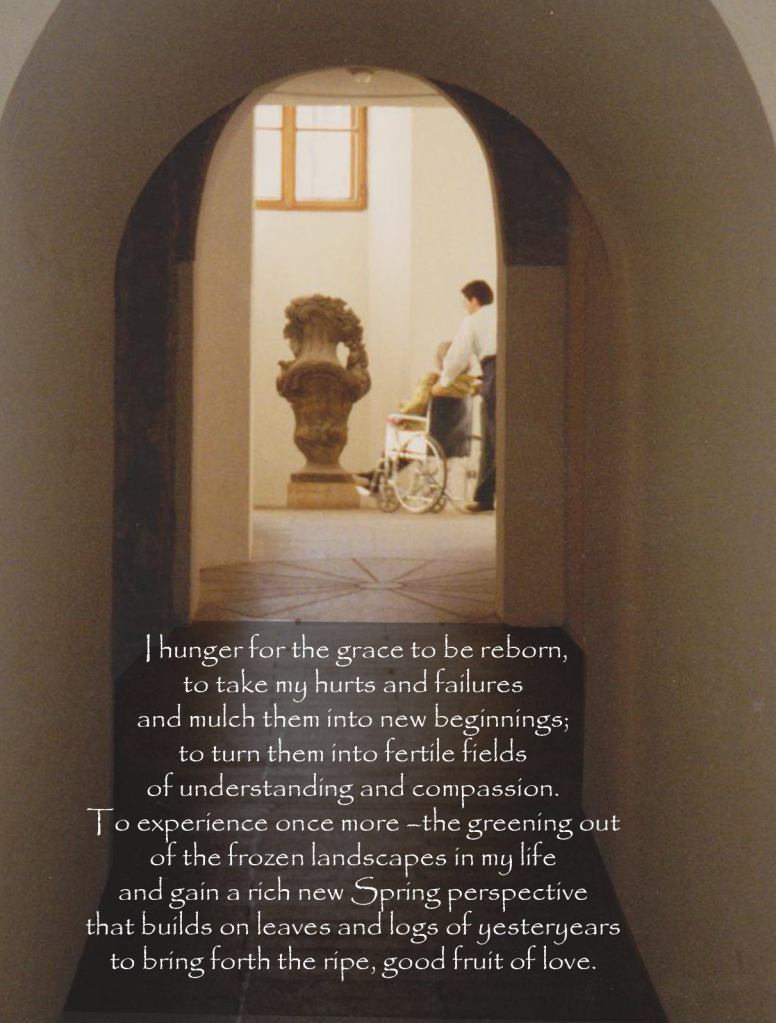
Celebrating our human potential for transformation, for resurrection.

Eileen's avatarLaughter: Carbonated Grace

Spring

View original post

We Are Not Called to Just Love Others as We Love Ourselves or to Do Unto Others as We Would Have Them Do Unto Us.

An area I disagree with many Christians about is that Jesus’ ultimate call to love is summed up in, “Love your neighbor as you love yourself” and “Do unto others what you would have them do unto you.” I think these are fundamentally limited ways to love. I have found from experience that, one: I often don’t love myself, and two: how I am able to accept and experience being loved is quite different from a lot of other people. I think at a later time in his journey, Jesus caught on to that too. Then he said to love others as He loved us. That greater love had no one than that they lay down their life for another. He laid down his desires, his gifts and ministries, his power, his limited vision of his purpose, his followers, even ultimately His awareness of God’s presence, as he hung on the cross. He gave up his self- hood. That’s a call most of us avoid hearing. Dying to self involves letting go of pretty much all of our preconceived ideas and natural inclinations in order to get outside of our own self and become able to hear/see/ respond lovingly and appropriately to those different from us. This dying to self is very very hard to do. It was so hard for Jesus that he literally bled in his anguish and then experienced deep despair in his feeling of abandonment by God.
Today, I think we get so nervous about something sounding like we are saying Jesus isn’t God, that we miss what we can learn from his life about our own journey. His life, God or not, was human. He didn’t spring forth fully grown, fully mature, completely understanding his mission, or knowing his future. He came as a baby, vulnerable, innocent, and ignorant. There are some obvious learning events in His life story, and there are also more subtle ones we often miss. Watch him as a twelve year old learn to wait on God’s timing and to consider his parents’ feelings and guidance. Watch him get pushed out of his comfort zone by his mother’s caring about a young couple’s embarrassment on their wedding day, watch him escape from his angry neighbors in Nazareth, but three years later, fully knowing the outcome setting his face toward a hostile Jerusalem, watch as he let’s a gentile woman convince him of his call to minister outside his own religious group as he recognizes the faith of even unbelievers, watch him weep as he recognizes that his own people will not accept his love and salvation, watch him test his power on a fig tree, but then recognize his own servanthood as he washes his disciples feet, watch him struggle in the garden with his realization that he must die young, watch him accept the agony of feeling abandoned by God on the cross, and yet still move to “Thy will be done.” Consider the difference in the difficulty of the moral code of the ten “Do Nots” and the spirituality of the “Beatitudes.” There’s way more to loving than most of us want to know.

Smart or Intelligent? Moral or Ethical? Religious or Spiritual?

Due to a bad case of writer’s block, I am reblogging more old posts.

Eileen's avatarLaughter: Carbonated Grace

11:27am
Being smart and being intelligent are different in practice. Being smart is more about the present moment and the practical, being intelligent is about learning from the past, so humanity can live both free and humanely in the future.

Morals and ethics are different also. Morals are about not doing evil, while ethics are about not achieving reasonable goals evilly. Morals are immediate and personal. Ethics are long term and social.

Ethics question whether an end, particularly the goal of our personal happiness,  justifies means that hurt people and that set precedents for corrupting society.

In trying to pass down values for a changing world, I want to challenge my descendants:

1. Morals: Don’t do it if you don’t want those you care about to read it on the front page or see it on U-tube.

2. Ethics:  Don’t do it if everyone else also doing it will make…

View original post 468 more words

The Delicate Dance of the Balance and Harmony of Paradox

To me, this is the key to personal and universal healing, transformation, wholeness, and peace. This is where grace can take us if we let go of the prejudices, fears and idols of our ego.

“The dichotomies of imagination and rationalization, intuition and intellect, heart and mind, heaven and earth, feminine and masculine need to be viewed less as polarities than as partners in a delicate dance of balance and harmony. Only by embracing all parts of ourselves are we able to know the wholeness of the world and our inherent inseparability and interdependence with it.”    Mini Farelly-Hansen
(Copied from the Blog: Make Believe Boutique)

The Broken Body

Reflecting on the Body,
you the hand, I the foot
Christ the head, perhaps the heart,
all at times the hidden part,
I let the Scriptures
flood my mind with images,
with suddenly one image,
a moving picture
so harshly real
I gasp aloud.

A person staggers
stumbles forward,
arms flailing, head jerking
back and forth in spasms,
body parts all pulling
different ways.

This then, reality,
Christ’s earthly body now.

God, forgive us.

Becoming Free to Hear God

I just want to reiterate my theme song: We are all born different.

I don’t have expertise in much, but personality differences have been my area of specialization since the early 1980’s. I used to be a consultant on their implications for marriage relationships, teaching/learning styles, approaches to spirituality and even management skills.

We are different in both what and how we take in information from the outer world
We are different in how we process what we take in.
We are different in what we value.
So, we are different in how we respond to what we take in.
We are incredibly different in how we communicate.
We are different in how we live in the world……whether goal driven, pleasure driven, influenced by others or our own built in agendas.
We are different in whether we are focused on the present moment, the past or the future.
Words have different meanings and even a totally different impact for each of us.
It is an absolute miracle that any random group of us can agree or act in concert on anything, even in the same family, church, culture or country, never-the-less across cultures, religions, and nationalities.

However, both my studies and experience have shown me that after midlife we have a natural inclination to grow and develop more in the opposite strengths and orientations. So, age may have its perks and probably the greatest of these is a greater potential for peacemaking.

Here is a part of my personal journey that hopefully illustrates this possibility.

In my mid-forties I was accepted into a three year course of preparation for Lay Ministry.
A part of it was taking a battery of tests ranging from IQ to personality tests. Then we were given feedback on areas that might be problematic for ministry.

I was told that I had two areas with a potential for limiting my effectiveness in ministry.

#1. My IQ was high enough that I most likely always assume that I am right in any conflict of opinion. This is a weakness, because no matter how smart anyone is, no one, but God is right all the time. And….(here is the zinger) the most necessary quality for hearing God is humility.

#2. I was over sensitive and thus, easily offended.(My humorous, but pitiful first gut level response to this was, “If you know that, why would you hurt my feelings by telling me?”)

It has been a long and somewhat painful process of integrating these truths into my conscious responses to life.

Several years ago, I got into a conflict with my church’s Minister and the leadership of the church. This culminated with a woman Elder telling me that I was just an unhappy person who was never satisfied with anything. Frustrated, hurt and angry, I left organized religion for about two years. During this period I focused on trying to listen to God and my relationship with God became much closer and more fruitful. This culminated in the realization that I was, in fact by nature, both extremely idealistic and a perfectionist. These traits have a good side; I have been at times a change agent for the better. However, since no person or organization is perfect, they tend to make me critical of pretty much everyone and everything.

The realities and practical limits of an imperfect world filled with imperfect people, including myself, are like a pebble in my shoe. Coming to grips with the reality that in this life, we can only inch toward any ideal, never reach it, is as painful for the idealist as accepting the call to change is for the pragmatist. The ultimate challenge for all of us is becoming free to hear God in each situation. Sometimes God’s choice is a matter of timing, sometimes what seems good, may need to be let go to make way for something better as yet unseen, sometimes more time is needed for grace to change other hearts.

This is my prayer variation: “God, help me to change what you want me to change, to accept what you want me to accept, and to hear which you are calling me to do in each situation.”

Here are the challenges that I am still in the process of learning on how to hear God:

#1. I must let go of the assumption that my way of seeing an issue is the best or God’s way. It might actually be, but I cannot see the whole picture or the long term effects like God can, so I cannot make my opinions into idols.

#2. I must consider the realities or practical limits of the situation and be willing to inch toward or even let go of what I consider the ideal.

#3. I must let God heal the hurt behind the anger that any conflict carries with it, such as feeling unappreciated, rejected, like a failure, or somehow inadequate.

#4. I must trust that God is in every situation and can teach me and others what we need to bring about spiritual growth and good out of what seems so wrong.

#5. It may be necessary for us to take time and space to heal our wounds, but we need to avoid burning bridges. Sin isn’t feeling hurt or angry or even needing time away from a situation.

Sin is refusing to take the time to seek the grace and do the work needed to reconcile, however long that may take.

Compassion or No One’s Playing with a Full Deck

From when I was quite young, I stayed stressed night and day over the possibility of being scolded for anything. Unfortunately, even if a fellow student was scolded, I also hurt for them, literally. My stomach would ache.  As an adult when a friend was going through a painful divorce, it seemed almost like I was going through it myself. In many ways this made me compassionate and I tried always to relieve others’ suffering in any way I could.

But, my life became controlled by an underlying need to relieve suffering of any kind, my own, my friends’, the world’s. This sounds like a good thing, and at times it undoubtedly was. But suffering is an inevitable part of life, everyone’s life. And a lot of suffering is self inflicted and perpetuated by attempts to escape it, rather than experience it and learn and grow from it.                                                                                                                                                                                                                                                                                                                       Compassion and fear of our own suffering may be two sides of the same coin.

Over the years I learned that I could not protect my children from suffering. And after a couple of friends, that I tried to give emotional support, ended up committing suicide, I gradually accepted that I am not God and cannot control life for anyone.

Eventually, I also recognized that some people become addicted to being victims and are bottomless pits of needs and wants that no one but God can fill.  I can be kind. I can share insights I’ve gained through my own struggles. I can bring a little laughter into the lives around me. But ultimately, each person’s journey is uniquely tailored to the process of making them into the people God created them to be…no more and no less. We can all only play the hand we were dealt and no one other than God can judge how well we are doing that.
Each person is born with their own set of genetic strengths and virtues. The thing we often overlook is that each strength has a corresponding area of weakness. Our pattern of growth will build on the strengths, but also will involve facing our weaknesses and allowing for them. We can develop survival skills in those areas, but they will never be our gifts.
That means we need one another. That means at times we must set aside our strengths and avail ourselves of the opposite set of gifts of other people. This is a dying to self of sorts. It involves suffering and humility. Not an easy task, but definitely part of becoming a couple, a family, a friend, a community, a nation, a world.

In other words, none of us is playing with a full deck! And we can help one another in partnerships, but not in dependency relationships that keep us from growing.

Compassion calls for not only kindness, but the capacity to accept suffering as part of our own lives and of life in general for everyone.
It comes down to the age old prayer: God help me to change what I can, accept what I can’t change and the wisdom to know the difference.

The Trap of Depression

I need to start with a disclaimer. My struggle with depression and the things that have helped me may not help anyone else. And there may be things that would have helped me more. I also believe that we are born with different chemical balances and that stages of life like puberty, pregnancy, and change of life can cause balances to get more out of whack for some people.(How’s that for medical terminology.)
Also, when the chips are down, I do believe deeply that I am loved, just as I am, by the only One who actually makes much difference at my stage of life and that means I know I am not alone when down in the pit of despair.

Depression is the emotional equivalent of an abscessed tooth. Self-hatred is a judgement and judgment is like cement that sets emotion into stone.The one thing about emotions is they are normally changeable, but self-hatred for being depressed locks us into the depression.

Those of us who have high, possibly unrealistic, expectations of ourselves and of life are vulnerable not only to depression, but particularly to a sense of failure and inadequacy that triggers self-hatred.

Depression is painful. And pain of any kind both saps our energy and centers us in on ourselves. (Remember the abscessed tooth.)

My first step for getting out of the mire of depression is to accept it. That doesn’t mean wallowing or giving up hope. It means accepting the reality of it, like we would an excruciating toothache, and cutting ourselves some slack by prioritizing and minimizing our obligations to the world. When we first experience the darkness of despair, we may need to stop our everyday world and get off for a time, but as we learn coping skills
we can lower our expectations and at least continue functioning in areas of our strengths. Eventually, if we get smart enough, we quit trying to give 120 % in our up times, so in the down times we can just slow down the pace a little and cope.

I’m convinced some of the problem is cultural, patriarchal, in fact. In the old hunter/warrior society emotions were considered weakness. We have to shut out empathy to kill a deer or a person. When we have to do these things to keep our family, village or tribe alive, we learn to compartmentalize our feelings. I’ve noticed that generally men handle women’s anger much better than our tears. I’ve known husbands that told their wives to stay in the bathroom to cry. I knew a seasoned Army Staff Sergeant, a veteran of two wars, who asked to be transferred from a safe cushy posting to a dangerous no frills one, because all his officers were women and they cried at Staff meetings. I could understand his reaction, but couldn’t help but wonder if all the officers in the various armies sat around crying would it cut down on wars?

I’m personally convinced that tears are a healthy release for tension and possibly one of the reasons women outlive men.

However, life goes on even when our every movement is like wading through quick sand and having to make even the smallest decision sets off panic. If we had an actual abscessed tooth, we would cut ourselves some slack and so would the world. But at this point in our culture, unless we are hospitalized, we and the world expect us to continue just as we usually do.

Some of us seem to be born with personalities that see possibilities, usually ideal scenarios, not necessarily based on life’s realities. We are not always easily identifiable, we may take on disguises such as Goth attire or metal appendages and flaunt the dark side to hide our fragile dreams of being heroes and our inner fear that there are no heroes.

Sometimes, we hide behind sarcasm or cynicism.

But, the truth is almost all humans are ordinary. We aren’t qualified to be extraordinary or called to save the world.

We are called to give a cup of water to the thirsty, a smile of welcome to the outcast, a hug to the discouraged, a piece of art to call attention to the beauty of the world, or a poem to remind us of others’ suffering, a song to soften hearts, laughter to lighten heavy hearts, even the gift of our honesty about our own failures to share our freedom to be a fallible human with others.

The list goes on and on and doesn’t require heroic measure or extraordinary talent.

I seem to have been born one of those with big dreams, high hopes, and many ideas. Unfortunately, I am lousy at detail and loathe the boredom of repetition, so my dreams and ideas remain just that, dreams and ideas. I’ve always hurt for others, worried about the whole world, and still sometimes have to work through the paralysis of depression when I can’t fix life for those I love who are in pain. It has taken me a long time to admit that it was hubris to think I could save the world or anyone in it. And that struggling with that delusion kept me from doing what I actually can do.

I used to not go to funerals because I couldn’t think of anything miraculously healing to say and feeling others’ sadness sent me into depression. Then, when my own father died, I realized that each person there represented someone that cared enough to come and that it truly helped me to know that his life mattered to others. They didn’t need to say anything.

My son, Tommy, when he was about three, taught me that you don’t have to say anything to help people feel loved. He would be doing his little boy thing and would suddenly stop and come over smiling to pat my hand or shoulder and then just go right back to what he was doing.
I called them “Tommy pats” and eventually when I saw a rainbow or caught all the green lights when running late, I called those, “God’s Tommy pats.” And even now, Julian and I will often stop and give each other a smile and a “Tommy pat.”

Once, when I was overwhelmed by fear of the lifelong consequences of a bad decision by one of my children, I poured out my heartbreak to my friend Paige. She simply wept with me. It’s hard to describe how much that helped me. Someone cared enough to feel my pain with me. I wasn’t alone inside it.

So, what I finally know now, is that when I am depressed because I am not extraordinary or heroic and even perhaps have lost it and made life darker for someone else, I can humbly do the ordinary. And if we all do these little things, no one will go thirsty, or be alone in their sorrow, or feel unloved. And we all, even the depressed, will experience the reality of the Psalm that says, “But then comes the morning, yesterdays sorrows behind.”